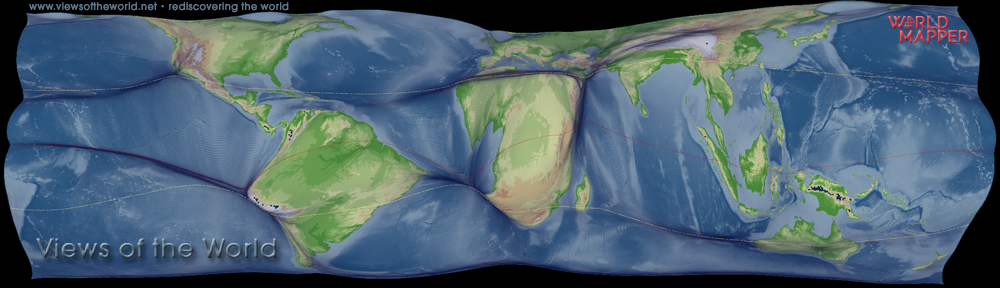
Changing times was the title of a session at this year’s Annual Symposium of the British Cartographic Society (not to be confused with the Society of Cartographers which will have its annual conference in September).
My contribution as a speaker in this session was titled Changing views of a changing planet. In the presentation I took a look at how changes in data and technology can provide alternative ways of mapping a globalised world, and mapping cities as the hotspots of globalisation. Continue reading
Tag Archives: britain
The Human Shape of Britain
The British monarchy is celebrating the 60-year reign of Queen Elizabeth II as the official head of state of the United Kingdom. The British Monarchy reaches beyond the boarders of the United Kingdom, making the Queen a constitutional monarch of (currently) 16 countries of the 54 members of the Commonwealth. Celebrations of the Diamond Jubilee will therefore not only be a matter of British subjects, a term which adds to the sometimes confusing geographical realities related to Britain. The epicentre of the events is of course the United Kingdom, especially the capital city London where the celebrations peak this (extended) weekend. The media is well prepared to get the global attention aligned to London ahead of the Olympics. In ongoing difficult economic times these upcoming events are a welcoming distraction for politicians to keep the population quiet.
To put the people back at the centre, here comes a new look at the population of the United Kingdom. The following map builds on the gridded population cartogram that I published on this website before (e.g. at this comparison of a choropleth density map and a cartogram, in this report of the Royal Commission, at this comparison of the different parts of the UK, or in this first London feature on this website). The new gridded population cartogram is a revised version using a much higher resolution population grid like in this population map of Germany. The data comes from the LandScan database which allows to map even more detail in the population distribution, which is why this new map shows a higher variation of population densities within the most densely populated areas. The map is the most detailed gridded population cartogram of the United Kingdom produced so far, which allows us to see even smaller cities in their population context. The map is an equal population projection where each grid cell is resized according to the number of people living there. It shows human shape of the United Kingdom in HD resolution as never before:

Britain in Snow
Another winter, another big freeze in the United Kingdom and Ireland: This winter has started early and brought the first significant snow cover to the British Isles at the beginning of December. Coming with a breeze of Arctic air from the North-East, the snow made its way down to the south of Great Britain, with Aqua satellite catching this moment at a time when some parts of the South-West still managed to escape the icing. This image from the NASA’s Earth Observatory shows the snow lingered in Great Britain and Ireland on December 8, 2010 with a few clouds over Northern Ireland and the South-East of England. To show the impact on the people living there, I reprojected the image using the gridded equal-population projection which transforms the picture according to the population distribution. Especially the snow-free areas in the South as well as in the Liverpool-Manchester region strike out in the population projection, showing that at this time the most severe affected areas were the less populated (what then was about to change, with the second cold spell bringing much more snow and ice to the more populated areas of the UK just in time for Christmas):
