A question often asked about Worldmapper is in regard to our choice of colours for the different regions and countries. On the website we briefly explain that the colours used on the maps group the territories into 12 geographical regions, and allow for an easier visual comparison between the maps than would otherwise be possible. The shading of each territory within a region is consistent throughout all of the maps.” But there is a little bit more to the colours which tell a story about the unequal fortunes of the world which follow a general pattern along the major regions.
The colours of the world’s regions are chosen very consciously, and have a deeper sense behind their distribution. We split the world into twelve contiguous geographical regions of population groups, with every region being roughly symmetrically balanced and having at least a population of one hundred million people. This is how the world’s population is distributed:
 Continue reading
Tag Archives: gridded population cartogram
Cubic globes
Last weekend I was invited to a workshop on future developments of society. The event took place in Berlin and was organised by the German research institution Fraunhofer-Institut für System- und Innovationsforschung (ISI) as part of the Foresight Process initiated by the German Federal Ministry of Education and Research (BMBF). The Foresight Process is described as ‘a strategic instrument (…) that provides technology foresight and the determination of future societal needs in terms of research and development‘. The workshop was a day full of creative buzz to squeeze interesting ideas out of the participants. To kick off the discussion everyone was asked to bring an item that symbolises one’s own work. For my work that had to be something abut maps. But to make it a more interesting item than a flat map I decided to craft a more sophisticated version of my maps that also stands for the challenging world views that lie behind the cartographic techniques that I work on. Cubic globes are not a new idea, but are quite handy when wanting just a little bit more than a simple map. They are much less work than creating a spheric version of the earth, and (as said by Carlos Furuti on his online cube globe collection) the cube is an ideal introduction to folding one’s own pseudoglobes.
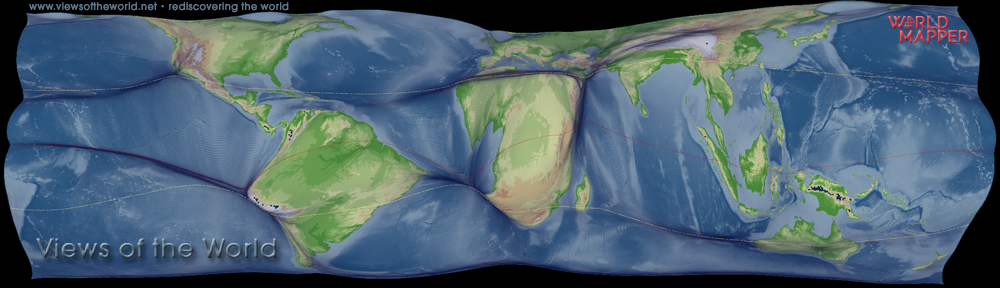
My very own version of a cubic globe is the World Population Globe which I took with me to the workshop. It shows my gridded world population cartogram including topographic and bathymetric details and is reprojected onto a six-sided figure with square sides. If you want to create your own world population cube from my map, you can use the following template, print it out and have your hands on with a pair of scissors and a little bit of glue. The key instructions are shown on the printout (make sure to click the image or the links below for a full-size DIN A4 version of the template). Change your views of the world – enjoy the world population cube!

(click here for a full-size jpg image – or here for a pdf version)