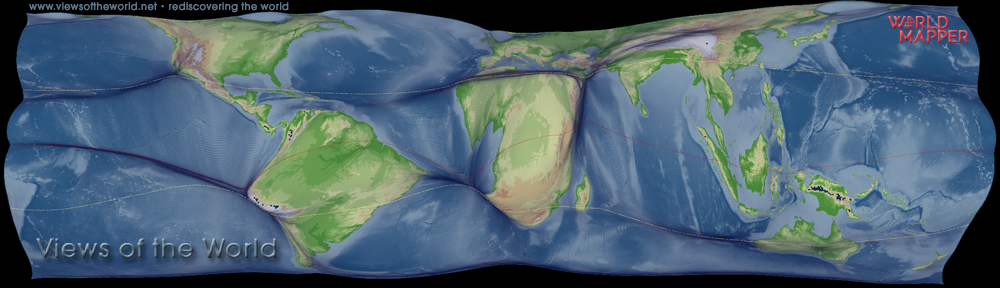
The effects of humans on the global environment are perceived to be so significant by some scientists that they argue humans have become a major driving force in environmental change on a par with the forces of nature. It is this rapid impact that has led some geologists to unofficially name (but not, as yet, officially recognise) this very recent period of the earth’s history as the Anthropocene.
Putting criticism and disputes over the geologic validity of this idea aside, the effects of human population and economic development as part of the processes of globalisation influence the natural environment as much as the natural environment previously determined the existence of human life across the globe. One part of our footprint are the major communication and transport infrastructure links that shape the human planet.
Tag Archives: geographical

Global Gender Inequality
The unequal treatment of individuals based on their gender is a deeply rooted problem in most societies. It started becoming an important part of academic research in the 1980s. The issue of gender inequality also became in various measures part of the Human Development Index (HDI), the annual report by the United Nations Development Programme (UNDP), and was eventually integrated as the Gender Inequality Index (GII) in the 2010 report. It is designed to measure the loss of achievement within a country caused by gender inequality.

Water worlds: Ocean Chlorophyll levels
Featured
The ocean is the last frontier that has not been discovered by cartogram techniques before. As such, it was an inevitable step in my PhD research some years ago to test the creation of a gridded ocean cartogram, a cartogram that is limited to the extent of the world’s oceans (also linking nicely to my past research on coastal ecosystems).
Chlorophyll concentrations in the world’s oceans are important indicators for the presence of algae and other plant-like organisms that carry out photosynthesis. As such, phytoplankton (which contains the chlorophyll) is an essential element of the food chain in the seas as it provides the food for numerous animals. Variations and changes in the chlorophyll levels are also relevant for the study of the ecology of the sea. Changing chlorophyll levels can indicate changing sea temperatures and other conditions in the oceans that cover about 72 percent of the planet’s surface.

Global tree cover
There is a long tradition in the emotional relationship between people and forests. We can get an understanding of the extent of the global tree cover from satellite sensors such as NASA’s MODIS
Calculating the average tree cover in an area allows us to estimate the extent of the world’s forests. Forest landscapes can be mapped in various ways and is often done in conventional maps. However, much of the land area is not covered by forest and the few remaining untouched forest landscapes keep shrinking while deforestation continues.
