Geovisualisierung im Zeitalter der Globalisierung

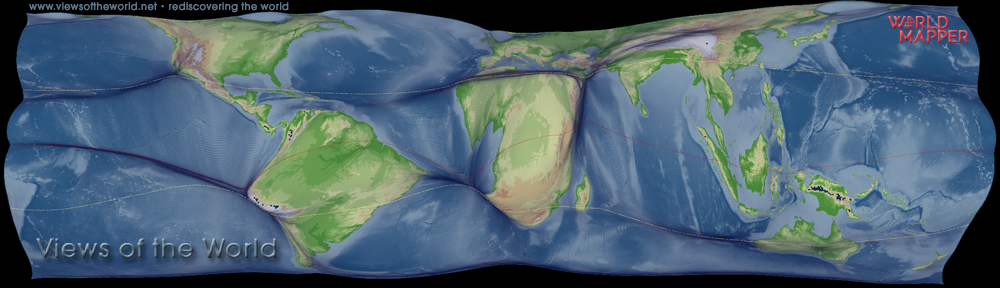
Unlike the post-apocalyptic scenario in infamous Waterworld, what would a world without oceans look like? An oceanless world, so to say, but not like one of the supercontinents that we already had. Instead, more like our today’s continents in the shape of the living space of humankind. In the digital era of cartography, this kind of map is just a few clicks (and much processing time) away, and results in this map curiosity: The image of the world as an oceanless population planet:

gridded population cartogram of an oceanless world
(click for larger version)

The map has been presented first at my talk for the DGfK‘s (German Cartographic Society) colloquium at the University of Applied Sciences in Karlsruhe (a German summary can be found here). In 2013 it has been published as a E&P A feature (see here).
As it was all about visualisation (and maps, of course), I used the Prezi presentation tool to visualise this talk. Here it is:

Continue reading

What I heard about the world

The Earth at Night as seen by NASAThis iconic composite image of the earth at night of NASA’s Defense Meteorological Satellites Program is the world as we imagine it when the earth is not facing the sun. But this image does not tell the full story of the night’s world, as it suggests that it shows where people are (because there is light). There are actually many people living with little light at night (and perhaps many others wish for some less light, but live in one of the bright spots of this image). Therefore, this image is some kind of fake thing when it comes to the real world at night. The real world at night for the world’s population looks more like the following map, which has been shown on this website before (see here). The reason for showing it again is not only that it has become the header-image of this website, but because the theatre performance What I heard about the World recently incorporated this map in the show’s announcements:

The Earth at Night shown on a World Population Cartogram(click for large image)
See here for an updated and more detailed version of this map

Continue reading

A brief look at map projections

Featured

Each and every map represents a distorted view of reality. Therefore, cartograms are not as unusual as they might appear at a first glance. Map projections are a central aspect of the Worldmapper project because the maps (respectively cartograms) featured in the project are basically not different from some sort of re-projection of the world, albeit in a different way than conventional projections used in cartography. Rather than trying to solve the conflicts of distortion when drawing a three dimensional surface on to a two dimensional area (be it a screen or a paper map), the worldmapper cartograms distort our image of the world on purpose and show each country in proportion to a specific topic. This is reason enough to reflect a little bit on what map projections are and in what way they create a distorted view of the world.

Worldmapper map using different projections

Continue reading

Money

Financial meltdown, recovery, inequality, injustice. Doom and gloom everywhere. But the world has been a strange place before, and it is very much about money. The following music video assembles a showcase of worldmapper maps to the lyrics and music of Money, a song by N.A.S.A. feat. David Byrne, Chuck D, Ras Congo, Seu Jorge & Z-Trip:

Money – Worldmapper Edition

There is a HD version available on YouTube, where you can also access the full accompanying lyrics as subtitles.

The content on this page has been created by Benjamin Hennig. Please contact me for further details on the terms of use.

2010 Worldcup goals map

Red and yellow dominated the final match of the worldcup with a remarkable 14 cards in these colours shown in the 120 minutes, and red-yellow eventually also taking the trophy, just as Paul predicted. One goal was enough for Spain, demonstrating once again their efficiency: Spain scored 8 of the tournament’s 145 goals in their seven matches to the title. The following map shows, how the nations compare in terms of goals – from Germany’s 16 (with Thomas Müller taking the Golden Boot) to Algeria’s. The second maps in contrast shows all goals conceded, from North Korea’s unfortunate 12 to Portugal and Switzerland’s 1:

All 2010 Worldcup goals on a map(click map for a larger view)

Continue reading

Worldcup Economics

The Football Worldcup is claimed to have a significant impact on the global economy, one of the reasons why so many countries are keen on hosting this event. Others are looking at the relationship between GDP and performance of teams at the Football Worldcup, which is well worth mapping. Here is a map that shows the participating countries of the 2010 Football Worldcup resized according to their Gross Domestic Product. In addition, all countries are coloured in different shadings of green – the darker green, the further the respective national team has proceeded in this year’s tournament. Obviously, economic wealth alone can’t buy success:

(click map for a larger view)

The previous map is of course missing out all other countries of the world. To complete the picture, the following map shows the same economic data (GDP), this time for the whole world, with the 32 nations participating in the 2010 Worldcup being coloured white, and those who missed out in black. The winners so far are marked with yellow stars (the number of stars indicating the numbers of trophys that a team has won at FIFA Worldcup tournaments):

(click map for a larger view)

Even if there may be links between economic wealth and success in football, this alone can hardly be the whole explanation for a team’s fortune. Interesting nevertheless to see, how the football world compares beyond the borders of the game.

The content on this page has been created by Benjamin Hennig. Please contact me for further details on the terms of use.