The glowing hearts in Vancouver eventually died down with the ending of the Winter Paralympics yesterday. Time for another review and another map: The following map shows the final results of the Paralympics with the countries of the world re-sized according to the total number of medals awarded at the Paralympics (click map for larger view):

This map becomes quite interesting when opposed to the results of the Olympics. The more affluent countries dominate the whole picture again at the Paralympics, but there are some obvious differences. China disappeared, Eastern Europe grew and Canada finally managed to catch up with the United States. Here is the map of the Olympics again:

Continue reading
Tag Archives: map
Vancouver 2010 medal count
The Winter Olympics in Vancouver yielded some great visualizations, with the New York Times work being amongst the top ones. They are showing off a map of the Winter Olympic Medals in the tradition of the Dorling cartograms. They also did a great job on a 3D map of the venues.
For those who want for worldmapper style maps, here is the relief: The worldmapper map of the actual medal count. The following is transformed due to a country’s total number of medals it has won.
 A larger version of the map can be viewed by clicking on the image.
Carbon emissions on a grid
Building upon the maps in the previous post we also created a gridded cartogram showing the national per capita emissions joined with the earlier introduced population grids. The resulting map gives an indication of the areas where most carbon emissions are produced beyond country boundaries:
The content on this page has been created by Benjamin Hennig. Please contact me for further details on the terms of use.
Copenhagen Carbon Maps
Carbon dioxide emissions are gaining yet another boost of attention in the countdown to the Copenhagen climate change summit. We took that as an opportunity to update our worldmapper carbon emissions map with more recent figures. The most reliable figures are compiled in the UNStats MDG reports providing global data for 2006. Using this dataset, we calculated the new Carbon Emissions Map, resizing the territories according to the proportion of carbon dioxide emissions (note: see more maps here):

Furthermore, we did some calculations to show the real dimension of CO2 emissions by the population in each of the countries (or territories). We re-coloured the previous map with per capita greenhouse gas emissions. These give us an indication how the major polluters compare related to their population’s individual levels of emissions:

Finally, any agreements in Copenhagen will be compared to what the Kyoto protocol proposed some 17 years ago. This refers to the 1990 levels of CO2 emissions, which we put on a third map: Again, we took the per capita consumption as a base for the colours, rather than the change in total emissions. In this map we can see which countries have improved their carbon dioxide footprint on an indiviual level copared to the per capita emissions in 1990 and which have changed for the worse:

The content on this page has been created by Benjamin Hennig. Please contact me for further details on the terms of use.
Map meets cartogram
Population densities can of course be mapped differently – obviously using common density maps. They can give a better clue where densities are highest, but they can hardly show what is behind those numbers: What does a certain density really mean? How many are the many that are living in the more dense areas? And how do those compare to other populated areas? This is what a cartogram can show far better – and also show more true, when mapping human-related figures.
The following map shows a density map compared to our UK population cartogram. None of these maps is worse or better, it all depends on the purpose what you want to show, so that our new maps do not supersede traditional mapping approaches…

The content on this page has been created by Benjamin Hennig. Please contact me for further details on the terms of use.
Ancient Worldmapper Map
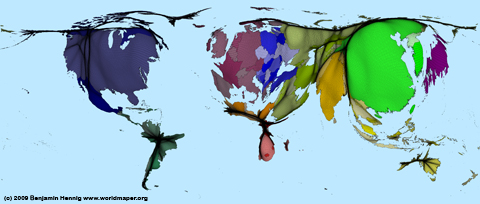
Surprisingly this ancient map shows the world’s population of the year 2005:

The content on this page has been created by Benjamin Hennig. Please contact me for further details on the terms of use.