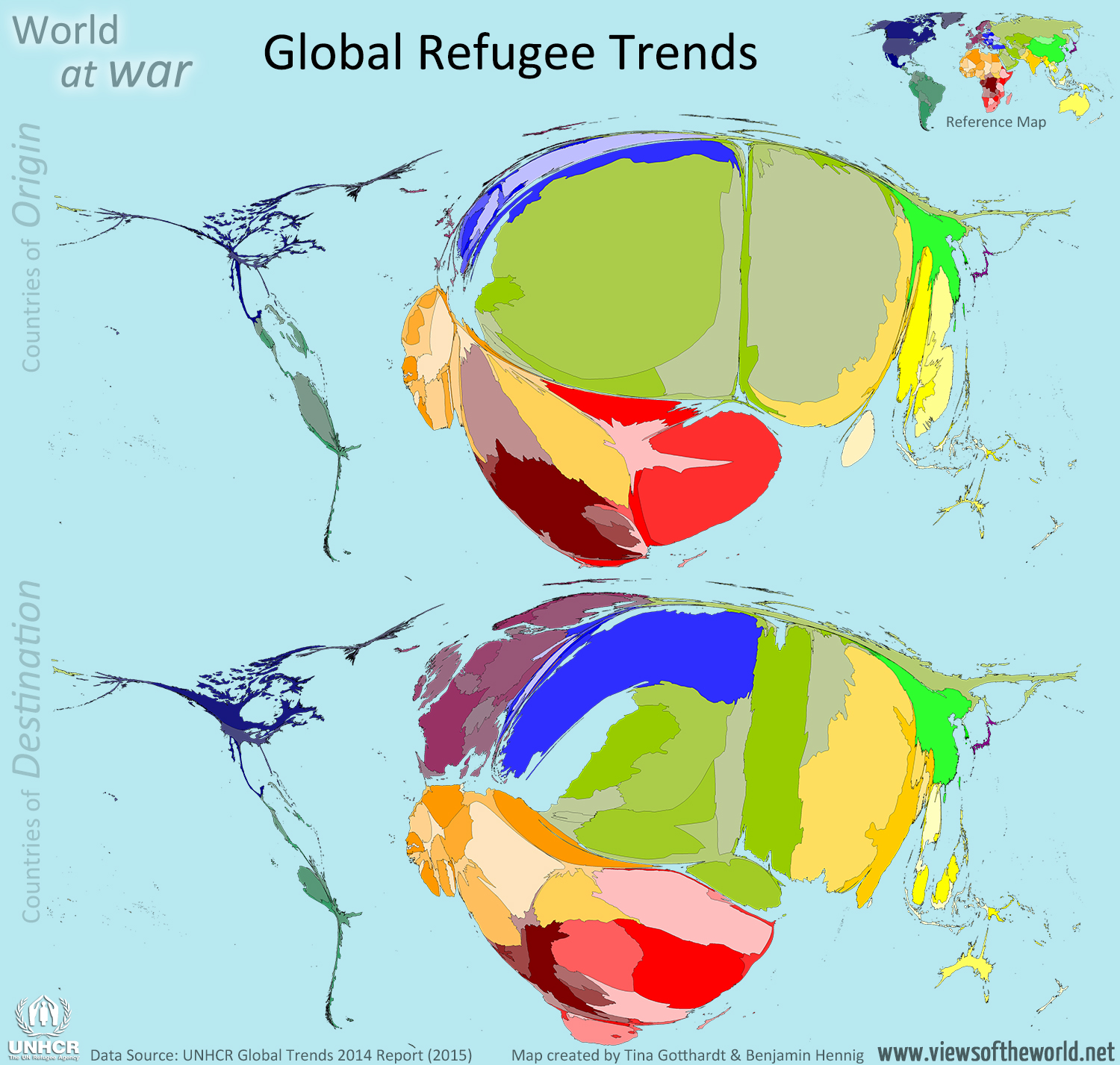
 The UNHCR Global Trends 2014 Report released earlier this week by the UN High Commissioner for Refugees finds that “wars, conflict and persecution have forced more people than at any other time since records began to flee their homes and seek refuge and safety elsewhere“.
Commemorating World Refugee Day, UN High Commissioner for Refugees António Guterres declared in a statement that “around the world, almost 60 million have been displaced by conflict and persecution. Nearly 20 million of them are refugees, and more than half are children. Their numbers are growing and accelerating, every single day, on every continent.” But while the ‘western’ media takes an often embarrassingly western-centric view, and European politicians struggling to find solutions to this global crisis, the report also shows how big this human crisis really has become.
The following two cartograms show the most recent picture of global refugee trends in 2014 as published in the 2015 UNHCR report. The two maps use the total numbers for ‘refugees and people in refugee-like situations’ according to their country of origin and destination and resizes each country according to its absolute number of refugees. Excluded in these maps are those refugees whose origin is unknown or who are stateless or cannot be assigned to a specific country:
Tag Archives: refugees
Migrants at Sea
Lampedusa has become a tragic symbol for a crisis and controversy that is discussed across the European Union. The Italian island in the Mediterranean Sea has become a prime transit point for immigrants from Africa and related to an ongoing tragedy in the waters between the European and African continent where people die on an almost daily basis while hoping for a better life in Europe. The debate has turned as far as the UK opposing future migrant rescues in Mediterranean. In a recent feature the Guardian newspaper published a range of statistics related to the topic, amongst them some figures that highlight the countries where refugees make it across the perilous waters into the EU from which I created the following cartogram that shows, which countries have to deal with which numbers of migrants arriving via the sea:

Displaced lifes: Escaping conflict, violence and disaster
“Every minute eight people leave everything behind to escape war, persecution or terror.” This is the background to the UN General Assembly’s decision to declare June, 20th as World Refugee Day. As the UN estimates, about “43.3 million people worldwide were forcibly displaced due to conflict and persecution” by the end of 2011. This includes several groups of people, categorised in refugees, asylum seekers, internally displaced persons, stateless persons and returnees. The following two maps put a spotlight on the geographic distribution of two of these groups. The first map visualises data on displaced people from a recent report by the Internal Displacement Monitoring Centre (IDMC). The organisation estimates figures on people who are internally displaced “caused by conflict, generalised violence, human rights violations and natural hazard-induced disasters”. The cartogram shows the countries of the world resized according to the total number of internally displaced people there, adding up to 33.3 million according to IDMC’s report:
