 The British debate about the United Kingdom’s membership in the European Union comes at a time in which the economic woes of the continent have not fully overcome yet. In an article for the “In Focus” section of Political Insight (December 2015, Volume 6, Issue 3) Dimitris Ballas, Danny Dorling and I looked at the changing regional economic geography of Europe.
Europe is in an economic crisis – but the crisis is felt in very different ways in different places. Official unemployment rates are high, especially in the south of Europe, but joblessness is very low in places, such as Germany
Tag Archives: europe

Asylum seekers in Europe 2014/15
2,500 people are believed to have died or gone missing on their way to Europe this year already, according to estimates by UNHCR. But it was the image of a young boy found dead on the shores of Turkey which changed the tone in the debate about the ongoing refugee crisis in Europe. While the response to the crisis varies strongly, Campaign groups are calling for a European-wide approach to the crisis. While Germany suspended the Dublin regulation to allow regugees into the country and claim asylum regardless of where they entered the European Union, the country also calls for a more equitable system of sharing refugees across the EU similar to Germany’s domestic approach of distributing refugees.
The following cartogram shows the current situation in Europe using Eurostat’s latest statistics about the number of asylum applicants in each country. The data covers the first half of 2015 (January to June) and adds up to 417,430 officially recorded claims in that period in the EU member states. The following map also includes those European countries which are not member of the European Union but part of the Schengen area and it shows each country resized according to the absolute number of asylum applications in that country from January to June 2015:

Refugees in Germany
As stated in a report earlier this year, “wars, conflict and persecution have forced more people than at any other time since records began to flee their homes and seek refuge and safety elsewhere” (see more details and a global map series at http://www.viewsoftheworld.net/?p=4541). In Europe, this has lead to a human crisis with many refugees seeking to get to the continent via sea and land. Beyond the human tragedy, the political debate has become ever more heated over who is willing to host the migrants.
Unlike the debate in the UK, where the government is more concerned about closing the borders into Britain at the most vulnerable entry point in France, Germany’s government is looking into ways how an expected 800,000 migrants can be accommodated this year. Using data from the most recent official statistics the following cartogram shows where refugees and asylum seekers are allocated in Germany showing the states (or Laender) rezised according to the absolute number of asylum seekers and refugees living there (the colours merely distinguish the different Laender and do not represent any further data):

Horsetrading: Equine Europe
There is a lot horsetrading going on in Europe. Literally. At the request of the European Commission the World Horse Welfare and Eurogroup for Animals have just published a report titled Removing the Blinkers which looks at the health and welfare of European Equidae in 2015. The report is the first comprehensive documentation of where horses are being kept in Europe, how they are kept, and how they are traded. The following cartogram shows a Europemapper-style cartogram depicting the EU population figures for equidea as stated in the report, using their mean figure (averaging the lowest and highest estimates for the number of horses in each country) which counts a total of just over 7 million horses in the European Union (compared to FAOSTAT estimates of only 4.3 million horses kept as livestock):

Migrants at Sea
Lampedusa has become a tragic symbol for a crisis and controversy that is discussed across the European Union. The Italian island in the Mediterranean Sea has become a prime transit point for immigrants from Africa and related to an ongoing tragedy in the waters between the European and African continent where people die on an almost daily basis while hoping for a better life in Europe. The debate has turned as far as the UK opposing future migrant rescues in Mediterranean. In a recent feature the Guardian newspaper published a range of statistics related to the topic, amongst them some figures that highlight the countries where refugees make it across the perilous waters into the EU from which I created the following cartogram that shows, which countries have to deal with which numbers of migrants arriving via the sea:

Violence against Women in the European Union
Everyone has a responsibility to prevent and end violence against women and girls, starting by challenging the culture of discrimination that allows it to continue.
UN Secretary-General Ban Ki-moon
Today’s International Day for the Elimination of Violence against Women raises awareness for an issue which on the campaign’s website is described as a global pandemic because of the discrimination against women and persisting inequalities between men and women: “35% of women and girls globally experience some form of physical and or sexual violence in their lifetime with up to seven in ten women facing this abuse in some countries. It is estimated that up to 30 million girls under the age of 15 remain at risk from FGM/C, and more than 130 million girls and women have undergone the procedure worldwide. Worldwide, more than 700 million women alive today were married as children, 250 million of whom were married before the age of 15. Girls who marry before the age of 18 are less likely to complete their education and more likely to experience domestic violence and complications in childbirth.”
These problems are a global phenomenon. In a recent report by the European Union Agency for Fundamental Rights it was concluded that “an estimated 13 million women in the EU were victims of physical violence during the 12 months before the survey” and “an estimated 1.5 million women in the EU were raped in the course of those 12 months.”
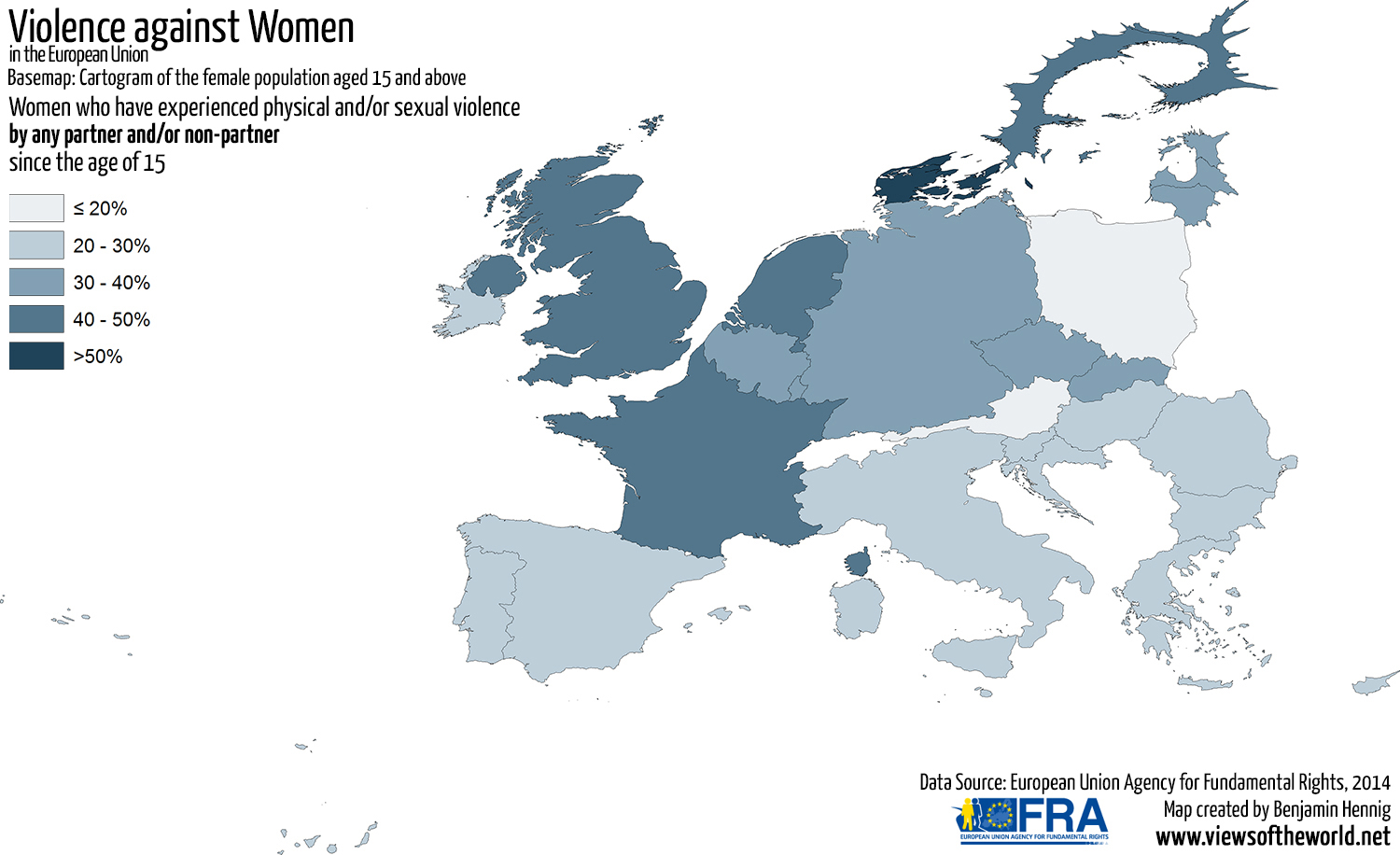
The following maps show some of the key data of the study in form of cartograms that use the number of adult women as a basemap, meaning that each country of the European Union is resized according to the total number of woman aged 15 and above to which the overlaid statistics relate in the survey. The maps show the real extent of violence against women in the EU. The first map summarises the data, while the second map series below splits the results from the study into violence within and outside relationships: