People across the worst hit countries by the proposed austerity measures to reduce national debt levels gathered on the streets of many European cities to protest against public spending cuts. The financial crash hugely affected many government across the EU with little signs of a quick recovery of the public debt levels.
The following map shows how Europe is left in deficit two years after Lehman (and that in fact the EURO zone isn’t worse off than EU members without the common currency). There may be signs of recovery, but this picture will certainly stay with us for a while:
Category Archives: maps

Magnificent Maps: Changing Perspectives
Magnificent Maps: Power, Propaganda and Art is an exhibition showing “80 of the largest, most impressive and beautiful maps ever made, from 200 AD to the present day”. The free exhibition still goes until 19 September 2010 at the The British Library in London.
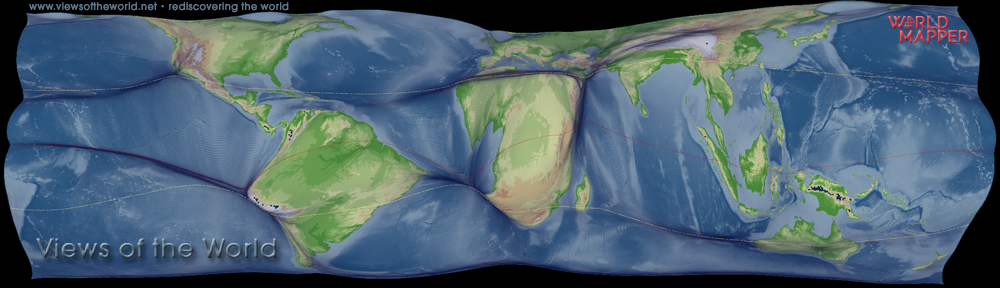
The following map has been shown by Danny Dorling in one of the accompanying events. The lecture Changing perspectives: mapping global injustice by changing the view? introduced a series of maps using the gridded cartogram technique, some of which were shown to a wider audience for the first time. This map is a reprojection of the world according to the population distribution based on an equally distributed grid. The grid size in this map equals a 0.25° raster on a conventional map and a composite satellite raster image of the world has been transformed accordingly, so that the map reflects the population distribution in relation to the landscapes on which people are living:

Pakistan’s Population
The monsoon rain has left a wide range of Pakistan‘s populated regions flooded. Especially the floodplains surrounding the River Indus are severly affected, as images of the Smos satellite show. Also other satellites, such as TerraSAR-X and the recently launched TanDEM-X support emergency response for the slowly growing international aid. These technologies are useful for location-related information, but to fully understand the dimension of the floods, it helps to have a closer look at the population distribution. The following gridded population cartogram (an enhanced version from the world population atlas) draws a picture of where people live in Pakistan. The underlying elevation information allows to understand the topography and the Indus is included for better orientation. The map shows that beyond the urban centres of the largest cities (labelled), much of the about 170 million people in the country are living along the rivers and in the floodplains while the Eastern and Southeastern regions remain less populated:

A brief look at map projections
Featured
Each and every map represents a distorted view of reality. Therefore, cartograms are not as unusual as they might appear at a first glance. Map projections are a central aspect of the Worldmapper project because the maps (respectively cartograms) featured in the project are basically not different from some sort of re-projection of the world, albeit in a different way than conventional projections used in cartography. Rather than trying to solve the conflicts of distortion when drawing a three dimensional surface on to a two dimensional area (be it a screen or a paper map), the worldmapper cartograms distort our image of the world on purpose and show each country in proportion to a specific topic. This is reason enough to reflect a little bit on what map projections are and in what way they create a distorted view of the world.

2010 Worldcup goals map
Red and yellow dominated the final match of the worldcup with a remarkable 14 cards in these colours shown in the 120 minutes, and red-yellow eventually also taking the trophy, just as Paul predicted. One goal was enough for Spain, demonstrating once again their efficiency: Spain scored 8 of the tournament’s 145 goals in their seven matches to the title. The following map shows, how the nations compare in terms of goals – from Germany’s 16 (with Thomas Müller taking the Golden Boot) to Algeria’s. The second maps in contrast shows all goals conceded, from North Korea’s unfortunate 12 to Portugal and Switzerland’s 1:
 (click map for a larger view)
Worldcup Economics
The Football Worldcup is claimed to have a significant impact on the global economy, one of the reasons why so many countries are keen on hosting this event. Others are looking at the relationship between GDP and performance of teams at the Football Worldcup, which is well worth mapping. Here is a map that shows the participating countries of the 2010 Football Worldcup resized according to their Gross Domestic Product. In addition, all countries are coloured in different shadings of green – the darker green, the further the respective national team has proceeded in this year’s tournament. Obviously, economic wealth alone can’t buy success:
 (click map for a larger view)
The previous map is of course missing out all other countries of the world. To complete the picture, the following map shows the same economic data (GDP), this time for the whole world, with the 32 nations participating in the 2010 Worldcup being coloured white, and those who missed out in black. The winners so far are marked with yellow stars (the number of stars indicating the numbers of trophys that a team has won at FIFA Worldcup tournaments):
 (click map for a larger view)
Even if there may be links between economic wealth and success in football, this alone can hardly be the whole explanation for a team’s fortune. Interesting nevertheless to see, how the football world compares beyond the borders of the game.
The content on this page has been created by Benjamin Hennig. Please contact me for further details on the terms of use.