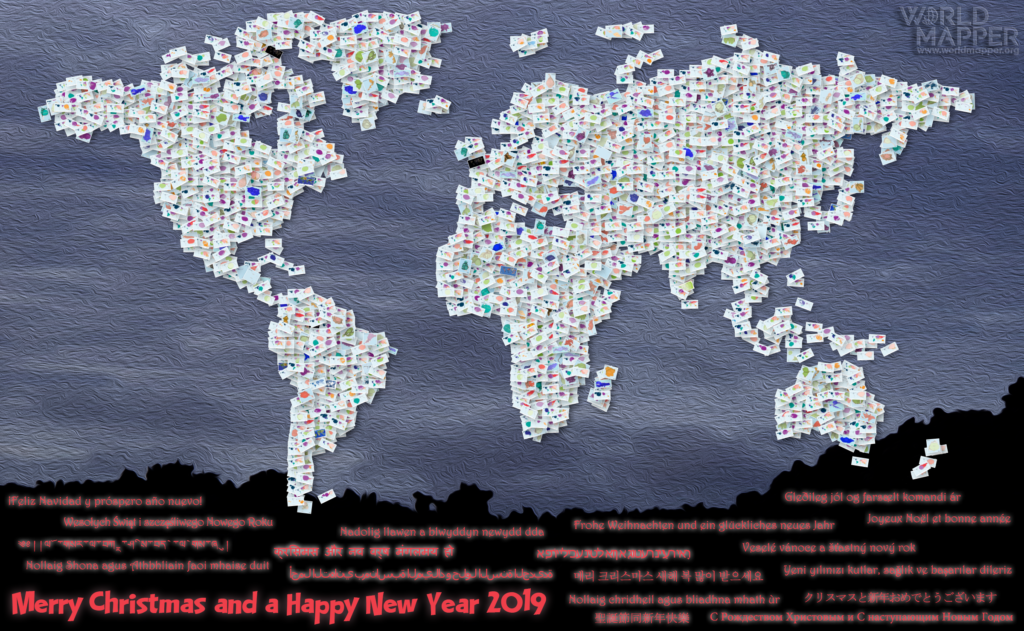
2018 has seen the new Worldmapper come to light, which is also why this blog has become a bit more quiet in recent months. This year’s Christmas greetings show a collage of the 569 new maps that we have published on Worldmapper since its launch in April:
 Continue reading
Yearly Archives: 2018
The Diamond Dimensions
Featured
Due to its distinct geologic conditions for their formations, the occurrence of diamonds is confined to around 35 countries in the world. While countries such as Australia, India, or Canada focus more on mining industrial diamonds, African countries such as Botswana and South Africa are better known for their production of gem diamonds. Diamond mining activities in many African countries are often also linked to conflicts and controversial human rights conditions.
According to data collected by the Kimberley Process Certification Scheme (KPCS), which covers an about 99.8 per cent of global diamond production, 134 million carats of diamonds worth US$ 12.4 billion were produced in 2016. This most recent figure is slightly up from the average annual production since the start of the financial crisis in 2008.

Gender Inequality in the European Union
How are the EU member nations faring in the fight for gender equality? It is a complex task to measure the progress that has been made in achieving equal gender rights. The Sustainable Development Goals provide a framework for the global level that is targeted at the most pressing issues of gender based discrimination. In addition to that, national governments as well as trans-national organisations such as the European Union have started concerted efforts to better understanding progress that is made in the different areas that relate to gender equality. This is often linked to developing new policies that aim to improve the situation in the different areas where gender issues matter.
The European Institute for Gender Equality has developed a Gender Equality Index that provides a measure for comparing member states over time in a range of areas relevant to European policymaking. The advantage of using an index is the possibility to use a single measure to monitor and track overall progress between the different countries. The combination of different indicators therefore does not prioritise a single issue of gender rights, but aims to support overall progress as an integrated challenge for achieving real change in thinking.

Language Diversity
There are approximately 7,000 languages believed to be spoken around the world. Despite this diversity, the majority of the world’s population speaks only a fraction of these languages. The three largest language groups (Mandarin, Spanish, and English) are spoken by more than 1.5 billion people. Other estimates state that 2/3 of the world’s population share only 12 languages.
But it is the diversity of the languages spoken by the few that makes language a remarkable cultural phenomenon. It is estimated that about 96 per cent of the languages are spoken by only 3 to 4 per cent of the people. 2,000 of the world’s languages have less than 1,000 native speakers.

Remembering Waldo Tobler
 Waldo Tobler is dead. He is most remembered for his affable manner, his very kindly smile, the remarkable longevity of this academic life, his great academic achievements and – much more importantly – for being very kind, especially to strangers. A generation of scholars who received his collected works on floppy disc (later on CD) is evidence for his commitment to engage with other scholars. He made no distinction between the hierarchies in academia and gave young scholars the same respect and attention as senior academics, acting as a mentor and source of inspiration to many of them. Understanding and discovery were his real aspirations. Continue reading
Danger Zones: Mapping Europe’s Earthquakes
Featured
A deeper understanding and better communication of earthquake risk has been a major challenge in geosciences for a long time. The Global Earthquake Model initiative aims to become the world’s most complete source of earthquake risk resources and works towards a globally accepted standard for risk assessment. As part of this collaborative initiative, the EU-funded SHARE (‘Seismic Hazard Harmonization in Europe’) project helped in generating the first consistent regional seismic hazard model for Europe (including Turkey). The model, published in 2013, overcomes the limitation of national borders and includes a thorough quantification of the uncertainties.
Seismic hazard data collected for this model consisted of records from more than 30,000 earthquakes with a magnitude of 3.5 and above on the Richter scale which occurred since the year 1000, as shown in the smaller map in this feature. To fully consider that hazards do not only reflect the mere occurrence of major seismic events, but also the damage they create, the model also factors in the earthquakes’ damaging effects. Moderate earthquakes in very densely populated regions can have a major impact. The vulnerability of populations depends on a multitude of factors that go beyond the actual earthquake’s magnitude.
