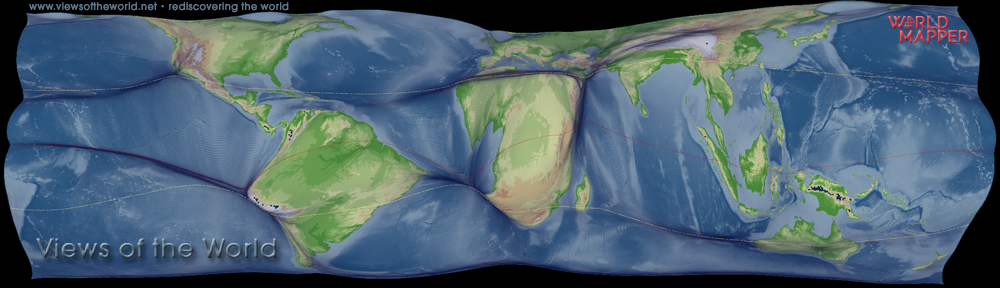
Changing times was the title of a session at this year’s Annual Symposium of the British Cartographic Society (not to be confused with the Society of Cartographers which will have its annual conference in September).
My contribution as a speaker in this session was titled Changing views of a changing planet. In the presentation I took a look at how changes in data and technology can provide alternative ways of mapping a globalised world, and mapping cities as the hotspots of globalisation. Continue reading
Tag Archives: cartogram
The Human Shape of Britain
The British monarchy is celebrating the 60-year reign of Queen Elizabeth II as the official head of state of the United Kingdom. The British Monarchy reaches beyond the boarders of the United Kingdom, making the Queen a constitutional monarch of (currently) 16 countries of the 54 members of the Commonwealth. Celebrations of the Diamond Jubilee will therefore not only be a matter of British subjects, a term which adds to the sometimes confusing geographical realities related to Britain. The epicentre of the events is of course the United Kingdom, especially the capital city London where the celebrations peak this (extended) weekend. The media is well prepared to get the global attention aligned to London ahead of the Olympics. In ongoing difficult economic times these upcoming events are a welcoming distraction for politicians to keep the population quiet.
To put the people back at the centre, here comes a new look at the population of the United Kingdom. The following map builds on the gridded population cartogram that I published on this website before (e.g. at this comparison of a choropleth density map and a cartogram, in this report of the Royal Commission, at this comparison of the different parts of the UK, or in this first London feature on this website). The new gridded population cartogram is a revised version using a much higher resolution population grid like in this population map of Germany. The data comes from the LandScan database which allows to map even more detail in the population distribution, which is why this new map shows a higher variation of population densities within the most densely populated areas. The map is the most detailed gridded population cartogram of the United Kingdom produced so far, which allows us to see even smaller cities in their population context. The map is an equal population projection where each grid cell is resized according to the number of people living there. It shows human shape of the United Kingdom in HD resolution as never before:

Inequalities in Immunisation
 Global inequalities in health find their expression in a wide range of issues that start in the very early ages of a person’s life. Children are most at risk, as health-related problems can have implications on the rest of their life – if they survive childhood at all. Finding the Final Fifth: Inequalities in Immunisation is the title of a new report published by Save the Children in partnership with ACTION and endorsed by the World Health Organisation.
The report takes a closer look at health inequalities related to immunisation coverage. With children being highly vulnerable, no access to immunisation is one of the preventable causes of death. Further efforts such as the Global Vaccine Action Plan (pdf) are needed to tackle the problem. “Reaching the hard-to-reach must be a priority for all countries“, concludes Save the Children in a statement prior to the 65th World Health Assembly where these issues were on the agenda.
The Worldmapper project contributed a cartogram series to the report, looking at some of the data that Save the Children used in its findings. The data shows how access to health and immunisation compares to mortality rates of children and how this data gives an indication of the prevailing global inequalities. We created four maps, of which three were included in the report (the following maps are modified version of these maps). All of the maps show the countries resized according to the total number of people for each topic that is visualised (i.e. these images work like a cartographic version of a pie chart). The original data sources are given in the report (download link see below). The first map shows the mortality of under-five year old children:

London’s Vote 2012
The old Mayor is the new Mayor of London as Boris Johnson secured a second term in office at this month’s election in the British capital. This left contender Ken Livingstone in second place at a campaign that was put the two personalities more into the spotlight than the underlying politics. Beyond the decision between Boris and Ken the elections provided an insight into how much the political patterns have changed since the last election in 2008. As a comparison to the feature published before the election, I created the same map series from the 2012 election results, giving an updated view of the political landscapes of London of all contestants and their respective political parties. This year’s election saw fewer candidates and resulted in a more polarised picture between the two main parties (Conservative and Labour) and the smaller ones. Nevertheless, the individual vote distributions of all participating parties (and candidates) result in specific patterns that correspond to the preferences of the population in London. Majorities of votes from each part of the political spectrum – from right to left wing views – are significantly distributed, not only when it comes to differences between Labour- and Conservative strongholds, but also for the smaller parties, as the following map series demonstrates by mapping the individual vote shares accordingly. The results are displayed on a gridded population cartogram of London (election data provided by London Elects):

Political Landscapes of London
Londoners will decide on their new mayor on the 3rd of May in this year’s mayoral election. Directly elected mayors were introduced in England in 2000 when Labour candidate Ken Livingstone was elected the first Mayor of London. He therefore also became the first to have this position in England under the Local Government Act 2000 introduced by the then Labour government under Prime Minister Tony Blair. Meanwhile, other cities have followed, and more will have a referendum on the issue on the same day Londoners go to the polls this year. Continue reading
In Focus: London’s political landscapes
 Ahead of this year’s vote we had a look at the geography of the 2008 London mayoral election. In an article for the “In Focus” section of Political Insight (April 2012, Volume 3, Issue 1) Danny Dorling and I analysed the patterns of first-preference votes at the last election in the UK’s capital city.
The map series that I created for this feature displays the distribution of first preference votes shares for each respective party that put up a candidate. This allows not only to see the eventual outcome (which resulted in the then mayor Ken Livingstone of Labour being put into second place but the current mayor Boris Johnson of the Conservatives), but also gave an impression of the distribution of preferences for the smaller political parties within the city, as most voters put their main party preference into their first vote, while giving their second preference to a stronger candidate of the larger parties. The maps are based on a gridded population cartogram of London (as featured in the London in Maps book). This is a preview of the maps that we created for the article (a larger version of this map can be found here):

Continue reading