 Good things come to those who wait. Today we are officially launching the Londonmapper website, a project that I started working on following the completion of my PhD in 2011. Over the past 2 1/2 years we developed the scope of the project which aims to become a new Social Atlas of London, a project that has not been undertaken since Shepherd et al’s work in the 1970s. But it wouldn’t be me if this would be an ordinary mapping project. Londonmapper is a growing collection of all kinds of cartograms that map a wide range of data to give a comprehensive picture of the diversity in the city. Continue reading
Tag Archives: cartograms
Londonmapper goes #geomob: Visualising London with Cartograms
Today I was invited to give a presentation at the quarterly #geomob meetup for location based service developers which this time took place at the Google Campus in East London. In my talk I gave a short preview of the Londonmapper project that I am working on with my colleagues and the Trust for London. Unfortunately technology played some tricks on us and some of the animated bits and content did not show up during the presentation, so that I promised to put these on my blog alongside the slides of the talk. Here we go…
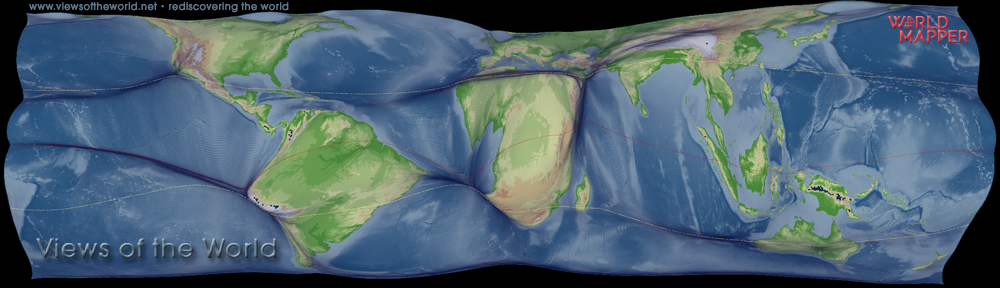
This first animation was an introduction into showing how cartograms work in general. I used a gridded population cartogram animation for Great Britain which I created years ago, demonstrating the approach of using a gridded cartogram to allow other layers being used in the transformed map. The following map (which is rather drafty as it was only a conceptual exercise) shows Great Britain overlaid with a topographic layer indicating the land elevation, as well as some key rivers and a selection of the motorway network. During the animation this map transforms from a conventional land area map into a gridded population cartogram where each grid cell is resized according to the total number of people living there. While the grid cells change their size, the other geographic layers are changed accordingly, so that the final cartogram shows these layers in relation to the population distribution, i.e. at which elevations do people live and how are people linked to major roads. The animation also demonstrates the magnifying lens effect in the most densely populated areas. Motorways and even the curvy shapes of the river Thames become visible now which at such a scale cannot be seen from a normal map. Gridded cartograms hence help to highlight details in these areas that are most relevant in the transformed space.

The Visualisation of Spatial Social Structure: Reflections on Critical Methods
‘(How) do we understand Capitalism? Reflections on critical methods’ was the title of a workshop on critical methods at the University of Manchester (September 13-14th). As the announcement of the workshop states, ‘there is no consensus on what critical social science is, exactly. Largely it is defined as not orthodox economics or positivist social science‘. Continue reading