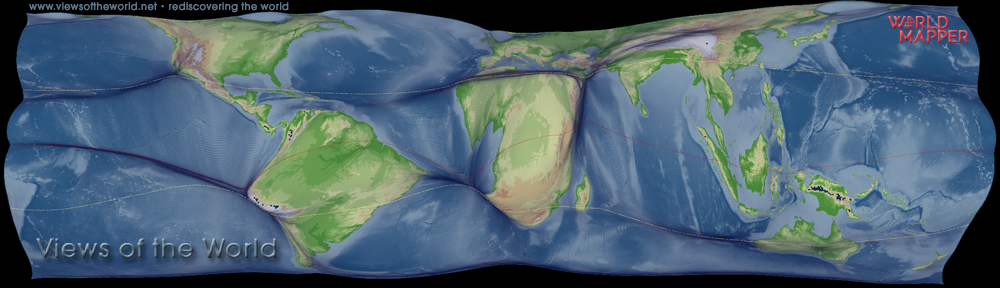
Following the foundation of the International Olympic Committee (IOC) in 1890 the 1896 Summer Olympics in Athens mark the beginning of the modern Olympic Games. 14 nations and 241 athletes competed in 43 events back then. The number of participating nations, of athletes and awarded medals has grown ever since. At the 30th Summer Olympics in London this year, 204 nations participated with 10,820 athletes who competed for medals in 302 events. After mapping the picture of this year’s event, it is also interesting to see how the modern Olympics of all time compare, with some interesting differences but also persisting patterns of success. The following map series shows where all the medals of the Olympics in the past 116 years went to (with the main map combining Summer and Winter games, and the two smaller maps showing the two separately):
Tag Archives: worldmapper

Olympic legacy: London 2012 medal maps
“A raucous pageant of popular culture” (Guardian) was the last act of the 30th Olympic Games in London, and discussion about the legacy of the Games started. From a global perspective, that legacy is often measured in sporting success – however great the ‘spirit’ of the Olympics is emphasized. So it comes as little surprise that the medal tables are revisited over and over again, with alternative ways of looking at the sporting success having proven quite popular this year. But despite an extraordinary performance of the host nation and some disappointments in other parts of the world, the overall picture of Olympic success stories is of little surprises.
Olympic inequalities already started with an imbalance of participating athletes from around the world (as shown in the map here) which hardly reflects the global population distribution. That pattern is carried forward to the winner’s podium, where in large the wealthier parts of the world are represented (even if some great exceptions have made quite some headlines). The following map shows the final medal tables in Worldmapper-style cartograms, with the main map representing the total medal count, and the smaller inset map splitting these numbers into separate maps of gold, silver and bronze medals, each resizing a country according to the number of medals that it has received (compare these maps to the map of participants and the map of the world’s population):

An inspired generation: London 2012 athletes
In a “Five-Ring Opening Circus, Weirdly and Unabashedly British” (New York Times) host city London welcomed the world to the 2012 Olympics. The games are meant to inspire a generation, which is the motto of the event.
And there was plenty of time to be inspired at the opening ceremony, especially while thousands of the more than 10,000 competitors took part in the athletes’ parade. But the size of a country’s team hardly reflects its population size, rather than the efforts and capabilities that are put into sending athletes to the Olympics. It is perhaps not surprising that Team GB of the host nation brings on the largest team with 541 athletes this time (or 557 according to the Guardian). The wealthier parts of the world tend to have the lager teams, with Europe dominating the stage by far. At the other end of the scale are countries such as Bhutan (and others) with only two athletes.
Beyond all the ancient spirit, the Olympics are an unequal game. Not only in the number of participants at the event, but eventually also in the results that will see a lot of the wealthy world dominate the medal rankings (which I mapped for the Vancouver Olympics). Nevertheless, part of the original idea is a peaceful competition of the nations, which many still see persist over all commercialisation and other points of criticism. In this light, this year’s athletes are the generation that has been inspired to be part of that and who shall inspire future generations, regardless of their success in bare medal terms. The following map shows where all the over 10,000 sportsmen and women have traveled to London from this year (the two inset maps show the world’s population distribution in comparison and a conventional land area map as a reference):

A year of crises: Global refugee trends
 “A report released by the UN High Commissioner for Refugees shows 2011 to have been a record year for forced displacement across borders, with more people becoming refugees than at any time since 2000. UNHCR’s ‘Global Trends 2011’ report details for the first time the extent of forced displacement from a string of major humanitarian crises that began in late 2010 in Côte d’Ivoire, and was quickly followed by others in Libya, Somalia, Sudan and elsewhere. In all, 4.3 million people were newly displaced, with a full 800,000 of these fleeing their countries and becoming refugees.” (Quoted from the UNHCR Press Release)
In the Worldmapper project we have mapped refugees before (see the maps of refugee origins and destinations) but these maps are far more outdated than most material that we have on Worldmapper. Not only provides the new report a comprehensive updated series of data, but also are refugee numbers of an extremely changing nature as they do not follow general mid- or long-term trends (such as changes in population or carbon emissions). As the introductory statement indicates, humanitarian crises and other hardly predictable events can result in changing refugee patterns.
The following two maps show the updated picture of refugee trends in 2011 as published in the UNHCR report this week (which also saw the commemoration of World Refugee Day “dedicated to raising awareness of the situation of refugees throughout the world“. The two maps use the total numbers for ‘refugees and people in refugee-like situations’ according to their country of origin and destination. Excluded in these maps are those refugees whose origin is unknown or who are stateless:

Inequalities in Immunisation
 Global inequalities in health find their expression in a wide range of issues that start in the very early ages of a person’s life. Children are most at risk, as health-related problems can have implications on the rest of their life – if they survive childhood at all. Finding the Final Fifth: Inequalities in Immunisation is the title of a new report published by Save the Children in partnership with ACTION and endorsed by the World Health Organisation.
The report takes a closer look at health inequalities related to immunisation coverage. With children being highly vulnerable, no access to immunisation is one of the preventable causes of death. Further efforts such as the Global Vaccine Action Plan (pdf) are needed to tackle the problem. “Reaching the hard-to-reach must be a priority for all countries“, concludes Save the Children in a statement prior to the 65th World Health Assembly where these issues were on the agenda.
The Worldmapper project contributed a cartogram series to the report, looking at some of the data that Save the Children used in its findings. The data shows how access to health and immunisation compares to mortality rates of children and how this data gives an indication of the prevailing global inequalities. We created four maps, of which three were included in the report (the following maps are modified version of these maps). All of the maps show the countries resized according to the total number of people for each topic that is visualised (i.e. these images work like a cartographic version of a pie chart). The original data sources are given in the report (download link see below). The first map shows the mortality of under-five year old children:

20 years of German exports
Europe’s Economic Powerhouse Drifts East read a headline in the New York Times last year, referring to the shifting economies not only within the European Union as shown in a series of cartograms on this website, but also in a wider sense. As the NYT states: “Last year [i.e. 2010], the euro area’s share of German exports fell to 41 percent from 43 percent in 2008, while Asia’s share rose to 16 percent from 12 percent, according to Bundesbank figures. During the same period, exports to Asia rose by €28 billion, while exports to the euro area fell by the same amount.” Continue reading