The previous post on this website already featured the map of the vote share in the US Congress related to the population distribution. But beyond the House of Representatives the voters in many US states had more to decide on: 37 Senate seats as well as 37 Governors were on the ballot paper. Here are the missing maps for these elections, shown in cartogram manner again. As the Senate grants each state the same number of Senators, a population-centric projection is less useful in this case. The following map thus transforms each state to have the same space on this map, so that the senate’s power distribution is better reflected in this depiction. The map only displays the results of last Tuesday’s election to the US Senate:
Category Archives: maps

Mapping the US midterm elections
Two years after Obama has been elected president, another political change has come to the United States in this year’s midterm elections. Politically most significant will be the changed balance of power in the House of Representatives, which has now a majority for the Republican party (winning 240 of the seats, compared to 186 going to the Democrats, and 9 undeclared at the time of writing). Unlike the seats in the US Senate (with still a small majority for the Democrats), the share of seats in the Congress reflects roughly a quite equal population. The congressional districts, which are the decisive constituencies for the House of Representatives, are thus reflecting a general image of the political mood in the US (while the Senate is composed of two Senators for each State, regardless of the population).
Therefore it makes sense to create a different map of the election results for the House of Representatives in order to show a population-centric view of this year’s midterm. The following map uses a gridded population projection and maps the election results onto it, so that it shows the proportional population share of the results in its true dimension: Each person on the following map has the same space, so it reflects the number of people represented by each member of congress. To see where changes took place, different shadings of red/blue have been used in addition. The map uses the same colour key as the election maps on the Guardian website – their map allows you to identify any of the States and gives further details on the results for each electoral district.
This is how the results from the election to the House of Representatives in the 2010 Midterm elections of the United States look like on a population projection (a geographical view with a conventional map is included as an inset to allow comparison with the more commonly used maps):

What I heard about the world
 This iconic composite image of the earth at night of NASA’s Defense Meteorological Satellites Program is the world as we imagine it when the earth is not facing the sun. But this image does not tell the full story of the night’s world, as it suggests that it shows where people are (because there is light). There are actually many people living with little light at night (and perhaps many others wish for some less light, but live in one of the bright spots of this image). Therefore, this image is some kind of fake thing when it comes to the real world at night. The real world at night for the world’s population looks more like the following map, which has been shown on this website before (see here). The reason for showing it again is not only that it has become the header-image of this website, but because the theatre performance What I heard about the World recently incorporated this map in the show’s announcements:
 (click for large image)
See here for an updated and more detailed version of this map
Serpentine Gallery Map Marathon
This map is part of this weekend’s Map Marathon at the Royal Geographical Society in London. It is an event of Serpentine Gallery and was conceived by curator Hans Ulrich Obrist (here an interview with him talking about the event) . This is a quote from the official announcement:
The Serpentine Gallery Map Marathon will bring together an unprecedented group from diverse fields to showcase possible maps for the coming decade. The Map Marathon will explore all forms of mapping, of data, space and time, multiple dimensions, language and the body. The event will uncover the influence and possibilities of mapping in our world today.
A similar version of this map has already been shown in some of my presentations (and those of the Sasi Research Group), and it is also a contribution for the forthcoming “Maps for the 21st Century” book to be published in 2011:

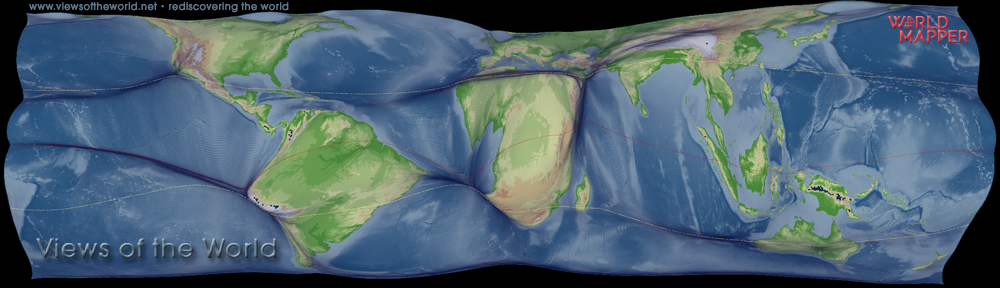
And this is part of the caption that goes along with the map: The new world map creates an unprecedented view on the world’s population which allows new perspectives for mapping the social dimension of our planet. The projection creates space in areas that matter most in a human world. Mapping the physical terrain onto this map reveals at which elevation most people live on earth. Most people living at high elevations live in East and South Africa, whereas in East Asia the densely populated coastal plains become apparent.
Continue reading
The Population of Germany
Today Germany is celebrating the 20th anniversary of unification of the until 1990 split East (German Democratic Republic) and West (Federal Republic of Germany). But while the areas have merged, in many people’s minds the division remains – recently prominently demonstrated in an interview by German chancellor Angela Merkel.
The dominance of the West is not least reflected by the population distribution between the two countries, with only Berlin being the most significantly populated area of the generally quite sparsely populated East of the country. Few other urban areas strike out when looking at the population distribution, which is displayed on the following gridded population cartogram. As the map in an equal-population depiction, each area of the map corresponds to the same number of people, so that the underlying geographical grid is distorted accordingly (reducing the size of less populated areas while increasing the size of the most populated areas). The colour code shows the population density in each of the grid cells (click the map to see further details in higher resolution):

Global Water Insecurity
Global threats to human water security and river biodiversity is the title of a new study that points out that almost 80% of the world’s population are exposed to some risk of insecure freshwater resources (published in Nature 467, 555-561 (30 September 2010) | doi:10.1038/nature09440). The researchers created a global raster plotting the security level of water resources based on an index of water threats which is discussed in their paper.
Much of the threats in wealthier countries can be counteracted with technology, which explains much less actual insecurity in these countries – but therefore puts biodiversity at risk and resulting in a high price for an inevitable resource of human life.
Talking to BBC News Peter McIntyre from the University of Wisconsin, one of the scientists involved in the study, puts it this way:
“But even in rich parts of the world, it’s not a sensible way to proceed. We could continue to build more dams and exploit deeper and deeper aquifers; but even if you can afford it, it’s not a cost-effective way of doing things.” (Source: BBC)
The unaltered stress level of global freshwater resources as published in the study is presented in this map (Source: Nature):

Accompanied by the map of biodiversity, this gives an interesting insight to the impacts on biodiversity. The impact on human population remains less shown in this depiction but is another crucial issue of the paper. As mentioned before, 80% of the world population are exposed to threatened water resources. By applying their map to the gridded-cartogram technique, the whole impact of these threatened water resources on the population becomes apparent. The 80% at risk become visible, as the map transformation preserves the geographical reference of the underlying grid. The emerging picture is going along quite well with the findings of the study and thus adds another interesting perspective on the issue of threatened water resources in the most populated regions in the world. All data from the study is available on http://www.riverthreat.net/data.html and we used that data to reproject the key maps of the study.
This map shows the “natural” picture of the human water security threat level from the study:

When taking the investments on water technology into account, this picture changes considerably, as the next map shows: