In the final year of his presidency Obama’s vision of a nuclear-free world proposed in 2009 seems far from becoming a reality. Although the countries with the largest arsenal of nuclear weapons (Russia and the USA) reducing their inventory, a recent report by the Stockholm International Peace Research Institute (SIPRI) states that China, France, Russia, and the UK “are either developing or deploying new weapon systems or have announced their intention to do so.” The state of the nuclear world therefore has changed very little in recent years, as SIPRI shows: “At the start of 2015, nine states — the United States, Russia, the United Kingdom, France, China, India, Pakistan, Israel and the Democratic People’s Republic of Korea (DPRK, or North Korea) — possessed approximately 15 850 nuclear weapons, of which 4300 were deployed with operational forces. Roughly 1800 of these weapons are kept in a state of high operational alert.” The following cartogram shows who the nuclear powers are in the world:
Yearly Archives: 2016

Mapping the Anthropocene
Featured
The effects of humans on the global environment are perceived to be so significant by some scientists that they argue the onset of industrialisation (in the eighteenth century) has been a major driving force in environmental change on a par with the forces of nature. It is this rapid impact that has led some geologists to unofficially name (but not, as yet, officially recognise) this recent period of the earth’s history (from around 1760-onwards) as the Anthropocene (roughly translating as the era – or epoch – shaped considerably through the actions of humanity).

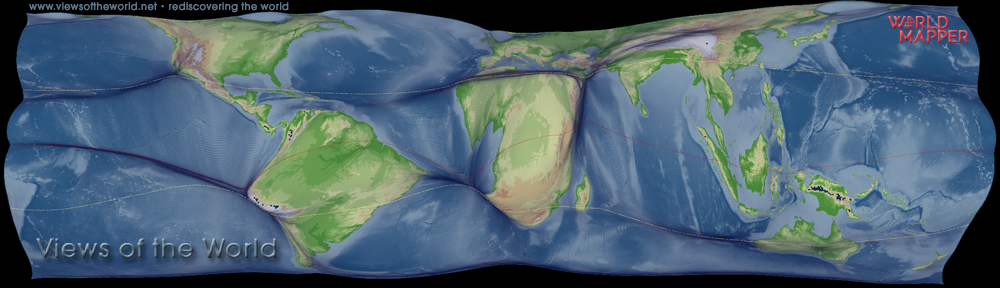
Gridded population cartogram displaying the topography of the world in relation to the population distribution (click here for larger version)