On July 11, 1987 the world population reached an unprecedented 5 billion, which was acknowledged with the establishment of World Population Day on that day ever since then. With the world’s population believed to reach 7 billion some time this year, this will obviously be a symbolic day (like it was back in 1987). But nobody knows how many of us are there exactly on this planet, and the number is constantly changing anyway. A nice animation of global statistics is shown in Worldometers, a website which turns all kinds of global statistics into live counts based on the estimated changes; at the time of writing this, the world population according to that website was at exactly 6,976,723,755…785…843…and counting; we also welcomed more than 208,000 new citizen to this planet while we also had to say goodbye to more than 95,700. Well, this is what World Population Day apparently is about: Making us think about the significance of population trends and related issues.
The worldmapper contribution to this year’s world population day is an updated version of the world population cartogram. The new map shows the countries of the world resized according to the total number of people living in each country in 2011 (using UNPD estimates). In a quick update, the world’s newest country South Sudan is also integrated in this map, so that this is the most recent population view that one can get of today’s countries:
Tag Archives: cartogram

Two Sudans
The human shape of the planet is constantly changing, so that the map of the world needs to be drawn every once in a while. On this 9th of July we are witnessing the birth of a new nation, with the south of Sudan officially becoming independent from its northern (now) neighbour. The following gridded population cartogram shows the population distribution within and between these two nations, giving every person living in the region the same amount of space. For the much smaller population in the south it will be hard work ahead in building a new nation, and for statisticians it will be similar hard work to improve on the population data that went into the creation of this map, as the pattern shows how crude the information about the population distribution in some parts of the two countries is – however, it still gives a good indication of where people living in the two new Sudans that are now on the world map:

A Blue Planet
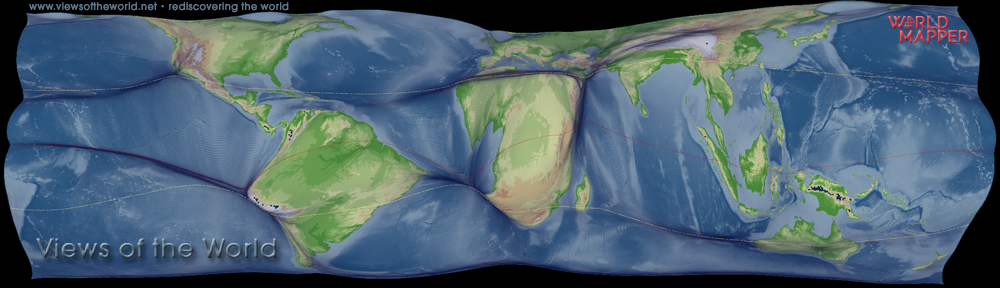
Maney, the publishers of the Cartographic Journal have today released their Maney Feature of the Month ‘Cartography & Surveying’ about cartography and surveying. Part of that feature is my contribution about some of the mapping results of my PhD research. It focuses on a series of maps that show the gridded cartogram technique applied to various themes from the human and physical environment, and briefly explains the underlying method.
As this blog entry also happens to be the 100th post on the Views of the World website, I have created a new version of the gridded world population cartogram. The map shows our blue planet a little brighter than the version that I created for the Maney feature (which puts the main focus on the topographic display), and also displays the major rivers traversing the spaces of humanity as pulsing arteries of an essential element. This is the ‘Blue Human Planet’:

Seeing the world through British eyes
A couple of months ago I looked into the global news coverage of the British Guardian newspaper which showed the distorted world views that we get from the printed media. Now a new media report by the International Broadcasting Trust and the University of East Anglia shows how British television viewers see the world according to the international coverage on the program (“Outside the box: How UK broadcasters portrayed the wider world in 2010 and how international content can achieve greater impact with audiences” by Martin Scott with Sandra Milena Rodriguez Rojas and Charlotte Jenner).
The foreword of the report says:
This research reveals how the nature of international factual coverage has remained remarkably static over time. Although individual producers and commissioners do not set out to reproduce the same view of the world on television each year, this study reveals that the combined result of all of those individual commissioning decisions, amongst all broadcasters, is to produce factual programmes that cover broadly the same topics, in the same formats, featuring the same parts of the world, every year.
Read more about the media report on Martin’s media blog and in the Guardian.
In collaboration with Martin Scott, the principal author of the report, I have created some worldmapper-style maps depicting the statistics used for this report. The following map is part of this map series, showing the amount of new factual programming received by different countries on British television in 2010:

A Revolutionary World
The people of the Arab world became a quite influential political voice in recent months, and the outcome of the Arab and the Middle East unrest remains unclear. But the events have put a region back on our mental map of the world that many had only in mind as either a holiday destination or a region to avoid. This picture has clearly changed, and many previously unknown places have become of people’s geographical knowledge. Why some places are more prominently named than others often has a direct link to the human geography of the countries where these recent events unfolded: The countries of the Arab world are characterised by diverse population patterns that draw a very different picture than the normal land areas suggest. Each of the countries human shapes can be seen in the World Population Atlas, which also provides a view of the global population patterns.
A coherent picture of the population patterns in the Arab region is given in the following new gridded population cartogram that I created from the countries of the Arab League member states, in which so far most of the democracy movements unfolded.
The Arab League has 22 member states with an estimated total population of 360 million who live in an area of 13,953,041 square kilometres (data from Wikipedia). The population density of 24.33/sqkm is less meaningful as a single figure. The population map shows that largest population densities concentrate along the coastal areas, while large areas are sparsely populated desert regions. The major population centres in the different countries were often the hotspots of the unfolding protests.
This is the human shape of the Arab world:

Megacities on the Map
Megacities are major global risk areas. Due to highest concentration of people and extreme dynamics, they are particularly prone to supply crises, social disorganization, political conflicts and natural disasters. Their vulnerability can be high.
This quote from the IGU’s MegaCity TaskForce draws a quite bleak picture of what some believe to be the future of living for humankind. The UN World Urbanisation Prospects finally saw the urban populations surpassing rural living for the first time in human history in recent years, but we must not forget that these urban populations do not all live in what is referred to as a megacity.
A megacity basically is nothing more than a very large city. Widely used is a population of 10 million, but other definitions do exist, ranging from 5 or 8 million, and some people, such as German geographer Bronger are also including the population density of 2000 p. per sq km as a defining factor). The definition of a megacity should also be seen as a rather vague delimitation for a phenomenon that – despite it’s quantitative dimension – has a very qualitative nature: What happens, when extremely large numbers of people live in a very limited amount of space, and what happens, if these areas of very high density living even continue growing.
In the year 2000 there were 39 cities with a population of more than 5 million inhabitants, 2/3 of which were in the developing countries. This was a population of 225 million people, not even 5% of the world’s population. Today we have about 400 million people living in the largest cities on the planet – still far from the majority of the now more than half of the world’s population living in cities. And perhaps the majority of people on this planet may never live in one of these megacities. Why is everyone talking about megacities then anyway? The sheer size make these cities the ultimate examples for urbanization, and provide an insight to the diverse processes in such complex urban spaces. They are like a real-life laboratory for urban geographers who try to understand the impact and implications of urbanization processes, and may contribute to solutions how the urban future of humanity can be actively created and lead to a better and perhaps more sustainable life on this planet.
A gridded population cartogram can help to understand not only the locations of these largest of cities, but provides a look into their setting within the global population patterns by giving space to people and allowing to see where many people live in these large cities, and where people are in relation to these cities. A normal map (see further down) shows the high concentration of megacities especially in Asia, but we can see from the population cartogram that these are in those anyway very densely populated regions, while the megacities in South America appear more like (relatively seen) solitary bodies.
