The Sendai earthquake in Japan sparked a debate about sustainable energy supplies of industrialised countries – with a controversial discussion about the safety and sustainability of nuclear power. The book ‘Sustainable Energy – without the hot air‘ by David MacKay is an outstanding read in this regard, outlining the all key issues that matter for our future energy need (the digital version is free, although I recommend the paperback which can even be read without wasting any electricity).
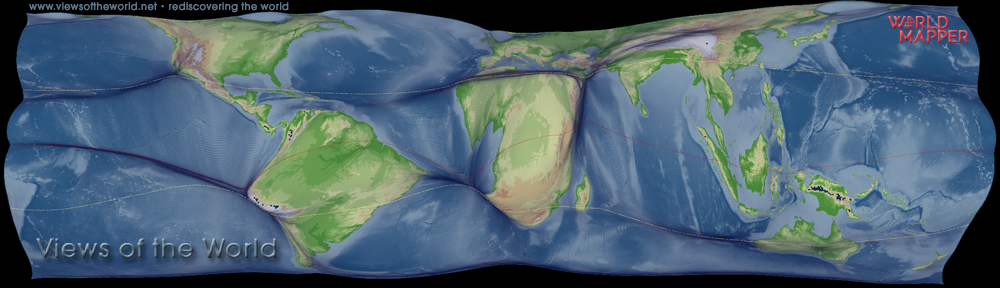
Switching the lights off was not a matter of choice for many people in the North of Japan after the devastations of the earthquake also affected the energy supplies (not only because of the Fukushima accident, but also because of a widely destroyed basic infrastructure). Another image featured in the NASA Earth Observatory takes a closer look at the electricity losses that occurred after the Earthquake by creating a composite image of two images of lights observed in 2010 and after the earthquake at March, 12 this year. As a highly industrialised country, the illuminated areas in Japan usually show the places where people live (see worldmap below), while dark areas are the unpopulated regions, hence the reprojection on a gridded population cartogram results in a dominantly bright image. Using NASAs display of the electricity losses therefore gives a good representation of the number of people affected by the power losses (and largely also the Tsunami and Earthquake itself) in the Northeast: The redrawn version of the image shows these as the red areas, while the brighter yellow areas in the South and West show the regions that has a similar illumination compared to the previous image. This is how ‘Japan at Night’ looked after the 2011 Earthquake:
 Continue reading
Tag Archives: cartogram
World Water Day

Water is a basic requirement for all life, yet water resources are facing increasing demands from, and competition among, users. In 1992, the UN General Assembly designated 22 March of each year as the World Day for Water
(quoted from the WWD website).
Water is more than a chemical substance contains one oxygen and two hydrogen atoms. Water has become a reason for conflicts and a controversial commodity, and yet, it is inevitable for every human being on the planet. The range of issues that are important when looking at water is diverse, and all fields reveal the global inequalities in access to clean water. One of these issues is the commercialisation of water, which on a global scale finds its manifestation in the bottled water industry: Bottled water is one way of getting access to clean water if there is no reliable central water supply or local source of water.
Edward Stanley from University College London looked at the bottled water business for a Geography dissertation project, for which I created some worldmapper maps visualising his data from that research on ‘Commodification and Mass Consumption – The Case for Bottled Water‘.
The topics that we mapped focus on the countries of origin of the globally operating bottled water companies and the bottled water consumption in the world. The first map shows the total bottled water consumption including a world population cartogram as a reference. In addition, the countries are shaded by their per capita consumption of bottled water (a worldmapper-style version of this map is shown at the bottom of this page):
Map I: Global Bottled Water Consumption (total and per capita) (click for larger view)
Mapping people, not sheep: Why our planet’s well-being can look so different
Today I held a talk at the IDEA CETL Applied Ethics Research seminar at the University of Leeds. My talk was titled ‘Mapping people, not sheep: Why our planet’s well-being can look so different’ and focused on issues of mapping well-being in new ways. Continue reading
A Population Map of Tibet
The 10th March is a controversial day in the history of Tibet: It marks the anniversary of a failed uprising against Chinese rule in 1959 and thus contributed considerably to todays political state. As the Tibet Autonomous Region it is now governed as a Chinese province, and political demands for an independent Tibet regularly find their way into the public debate. The latest in these developments is the announcement of the spiritual leader of Tibetan Buddhism, the Dalai Lama, to retire from political life. While the Tibetan Parliament is a government-in-exile, ethnic Tibetans are estimated to make up 93% of the population within the Tibet Autonomous Region, with an increasing rise of Han Chinese in the last decades. The total population living in Tibet is estimated to be 2.91 million, and the region has China’s lowest population density, with only 2.2 people per square km. Hence it is no surprise that the gridded population cartogram of China in the world population atlas gives Tibet little space in the map there (situated below the larger bulge that is Urumqi, and by far degraded by China’s populous Eastern provinces). To get a better picture of the population distribution within the region, I created a gridded population cartogram for the area of Tibet which gives a more detailed impression of the Tibet’s population distribution (using the boundaries of the Tibet Autonomous Region). The population cartogram also includes a transformed topographic display that illustrates at which elevations most people live in this region that is the highest region on earth :

The International Year of Forests 2011
 The United Nations General Assembly declared 2011 as the International Year of Forests (IYF) to raise awareness on sustainable management, conservation and sustainable development of all types of forests. The British Prime Minister Cameron experienced, how forests can become a very political issue, which shows how emotional people’s attitude towards their environment can sometimes become. The International Year of Forests, however, was never mentioned in the debate that went on during the proposed forest sell-off by the British government, which highlights one of the problems that sometimes these proposed International-Years-of-Something face: A lack of attention. On a global scale, 31% of the land area is covered by forests. Some of these areas are highly under threat by unsustainable forestry and environmental pollution. The IYF therefore is meant to emphasise “the need for sustainable management of all types of forests, including fragile forest ecosystems” (UN resolution on the IYF). Continue reading
Demographic Trends of Greater London 2001-2031

 Demographic trends in the United Kingdom, such as these discussed in the report on Demographic Change and the Environment, show an ongoing population growth in the south-east of England. With London being the dominating city in the UK’s economy, this is little surprising, as key industries but also most key institutions are still located in the capital city. This is one major reason why the southeast is like a population magnet that will have to find strategies to cope with an increasing population if these conditions persist. Demographic trends do also predict a slowdown in population increase over the next decades, with an aging society and declining birth rates as they can already be observed in Germany or most Easter European countries. All trends include challenges for policy making and planning, which is why population projections play a key role for urban planners to face future challenges in their decision-making. The Greater London Authority as the key administrative body for the most populous area in the UK (see map) released such projections on borough level to the year 2031, including population estimates for the past years (see London Datastore) which I have used for some of my research recently. Following a series of population maps created from this data by Spatial Analysis I used this data to create a population cartogram animation for the 30 years covered by this data which shows the changing shares of the population within the boroughs of Greater London, including a colour code for the net migration (taking population change, births and deaths into account). This is how the London population trends look like: Continue reading