Geovisualisierung im Zeitalter der Globalisierung

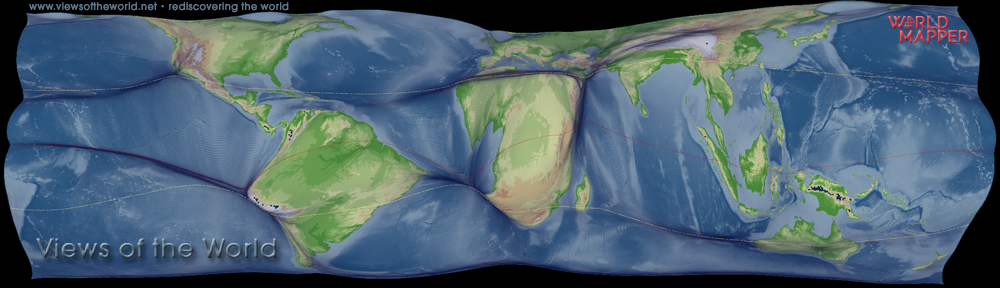
Unlike the post-apocalyptic scenario in infamous Waterworld, what would a world without oceans look like? An oceanless world, so to say, but not like one of the supercontinents that we already had. Instead, more like our today’s continents in the shape of the living space of humankind. In the digital era of cartography, this kind of map is just a few clicks (and much processing time) away, and results in this map curiosity: The image of the world as an oceanless population planet:

gridded population cartogram of an oceanless world
(click for larger version)

The map has been presented first at my talk for the DGfK‘s (German Cartographic Society) colloquium at the University of Applied Sciences in Karlsruhe (a German summary can be found here). In 2013 it has been published as a E&P A feature (see here).
As it was all about visualisation (and maps, of course), I used the Prezi presentation tool to visualise this talk. Here it is:

Continue reading

Global Water Insecurity

Global threats to human water security and river biodiversity is the title of a new study that points out that almost 80% of the world’s population are exposed to some risk of insecure freshwater resources (published in Nature 467, 555-561 (30 September 2010) | doi:10.1038/nature09440). The researchers created a global raster plotting the security level of water resources based on an index of water threats which is discussed in their paper.
Much of the threats in wealthier countries can be counteracted with technology, which explains much less actual insecurity in these countries – but therefore puts biodiversity at risk and resulting in a high price for an inevitable resource of human life.
Talking to BBC News Peter McIntyre from the University of Wisconsin, one of the scientists involved in the study, puts it this way:

“But even in rich parts of the world, it’s not a sensible way to proceed. We could continue to build more dams and exploit deeper and deeper aquifers; but even if you can afford it, it’s not a cost-effective way of doing things.” (Source: BBC)

The unaltered stress level of global freshwater resources as published in the study is presented in this map (Source: Nature):
Global geography of incident threat to human water security and biodiversity / Source: Nature
Accompanied by the map of biodiversity, this gives an interesting insight to the impacts on biodiversity. The impact on human population remains less shown in this depiction but is another crucial issue of the paper. As mentioned before, 80% of the world population are exposed to threatened water resources. By applying their map to the gridded-cartogram technique, the whole impact of these threatened water resources on the population becomes apparent. The 80% at risk become visible, as the map transformation preserves the geographical reference of the underlying grid. The emerging picture is going along quite well with the findings of the study and thus adds another interesting perspective on the issue of threatened water resources in the most populated regions in the world. All data from the study is available on http://www.riverthreat.net/data.html and we used that data to reproject the key maps of the study.
This map shows the “natural” picture of the human water security threat level from the study:

Map of Global Water Insecurity
(click for larger version)

When taking the investments on water technology into account, this picture changes considerably, as the next map shows:

Continue reading

Magnificent Maps: Changing Perspectives

Magnificent Maps: Power, Propaganda and Art is an exhibition showing “80 of the largest, most impressive and beautiful maps ever made, from 200 AD to the present day”. The free exhibition still goes until 19 September 2010 at the The British Library in London.

The following map has been shown by Danny Dorling in one of the accompanying events. The lecture Changing perspectives: mapping global injustice by changing the view? introduced a series of maps using the gridded cartogram technique, some of which were shown to a wider audience for the first time. This map is a reprojection of the world according to the population distribution based on an equally distributed grid. The grid size in this map equals a 0.25° raster on a conventional map and a composite satellite raster image of the world has been transformed accordingly, so that the map reflects the population distribution in relation to the landscapes on which people are living:

Composite satellite image projected on a gridded world population cartogram
(click for larger view)

Continue reading

The Real World at Night

The night view of the earth has become a very popular depiction of this planet. Although the NASA itself says that “The brightest areas of the Earth are the most urbanized, but not necessarily the most populated” many people mistake this view as a representation of the inhabited places on the globe. Our gridded population cartogram can help to get a better understanding of the relation of people and light. The following map is a reprojection of the earth at night that shows the nightview in relation to the population distribution. The gridlines are kept in a light colour and thus allow to identify those areas where the lines converge (representing the unpopulated regions). In contrast, the populated areas are given the most space, so that one can easily see which populated areas are literally illuminated at night – and where there are people living in darkness. The resulting map is an impressive picture of an unequal world, with large parts of Africa living in darkness, and the affluent countries in Europe and North America glowing in the dark:

The Earth at Night projected on a gridded population cartogram(click for large image)
See here for an updated and more detailed version of this map

Continue reading

Capitalism in Crisis?

The following two maps show the countries of Europe and the World resized according to their total external debt, whereas the colours indicate a country’s debt by gdp ratio. The maps are an outcome of a commissioned work for the Times newspaper, and putting those two slightly different values on one map may raise criticism, even if both values on it’s own make for a good depiction of the current state of the economic world – or the burden that some national governments currently face. Also, the data used must be judged carefully. Not just since Greece went on the global stage with its crisis it is quite obvious that economic statistics do not always reveal the real truth. Having said all that, these maps still draw an impressive picture of the current crisis in Europe and the world:

Map of debt and the debt/gdp ratio in the countries of the European Union 2010(click map for larger view)

(click here for large map)

Continue reading

Vancouver revisited: Paralympics vs Olympics

The glowing hearts in Vancouver eventually died down with the ending of the Winter Paralympics yesterday. Time for another review and another map: The following map shows the final results of the Paralympics with the countries of the world re-sized according to the total number of medals awarded at the Paralympics (click map for larger view):

This map becomes quite interesting when opposed to the results of the Olympics. The more affluent countries dominate the whole picture again at the Paralympics, but there are some obvious differences. China disappeared, Eastern Europe grew and Canada finally managed to catch up with the United States. Here is the map of the Olympics again:

Continue reading