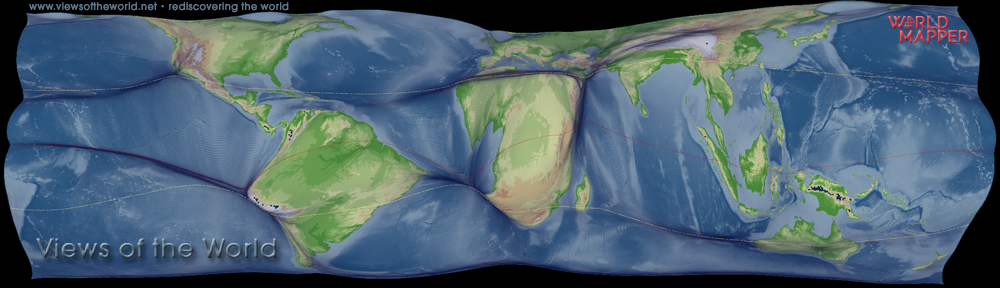
 Last November’s theme of the Super Science Saturday at the Oxford University Museum of Natural History was Planet Earth. As part of the activities I contributed a map cube which I created a few years ago.
Cubic globes are not a new idea. They put a nice twist to showing just a simple map, and more importantly, they allow for some activity which get the kids involved just as much as adults. A cube is much less work than creating a spheric version of Earth, and (as said by Carlos Furuti on his online cube globe collection) the cube is an ideal introduction to folding one’s own pseudoglobes.
At last November’s Super Science Saturday I displayed some of my work and offered a ‘Map Cube Activity’ where children (and adults) could cut, fold and glue their own globes. My version of a map cube does not display a normal world map, but a gridded population cartogram (hence the name ‘World Population Cube’). You can create your own cube by using the following template: Continue reading
Tag Archives: gridded population cartogram
Global Temperature Anomalies
Recent figures released by the NASA as well as the British Met Office and NOAA confirm that 2015 was the hottest year ever recorded. In addition, the period of the past five years was also the warmest in recent times. The following map animation visualises a data series by NASA’s Goddard Institute for Space Studies (GISS) that depicts “how much various regions of the world have warmed or cooled when compared with a base period of 1951-1980. They show temperature anomalies, or changes, not absolute temperature. (The global mean surface air temperature for that period was estimated to be 14°C or 57°F.)” It uses an equal population project in form of a gridded cartogram so that the underlying temperature anomalies can seen in relation to the global population distribution:

Visualising Urban Agglomerations in Germany
Read/cite the original publication here:
Hennig, B.D. (2018): The growth and decline of urban agglomerations in Germany. Environment and Planning A: Economy and Space. DOI:10.1177/2F0308518X18798835
Hennig, B.D. (2018): The growth and decline of urban agglomerations in Germany. Environment and Planning A: Economy and Space. DOI:10.1177/2F0308518X18798835
Electoral Doctrine: Thirty-nine maps of voting
The 2015 UK general election is history and many stories have been told about the unexpected victory of the Conservative party. But the picture of the election is far more diverse than it seems and the political landscapes are more polarised than a conventional map of the first votes can show.
This poster, submitted as an entry to the joint BCS-SoC ‘Mapping Together’ Conference starting tomorrow in York, presents the electoral doctrine of the 2015 election. It is a cartographic roundup of the beliefs of the electorate in thirty-nine images that tell the full story of a shift in political paradigms that will shape the debates for the elections to come:

Anthropocene Worlds
The effects of humans on the global environment are perceived to be so significant by some scientists that they argue humans have become a major driving force in environmental change on a par with the forces of nature. It is this rapid impact that has led some geologists to unofficially name (but not, as yet, officially recognise) this very recent period of the earth’s history as the Anthropocene.
Putting criticism and disputes over the geologic validity of this idea aside, the effects of human population and economic development as part of the processes of globalisation influence the natural environment as much as the natural environment previously determined the existence of human life across the globe. One part of our footprint are the major communication and transport infrastructure links that shape the human planet.

Global Gender Gap in Secondary Education
100% Equality was the theme of a session at this year’s Nexus Europe Youth Summit in London last week. As a member of the panel I started off by giving a global overview of the state of gender (in)equality and how this is being measured by different institutions, such as the United Nations Development Programme, the World Economic Forum, or the European Institute for Gender Equality. While they draw very different pictures in their detailed indicators, there are also a lot of similarities, with the European Nordic countries almost always being in the top spots of the overall index, which does not mean that in any of these countries absolute gender equality has been achieved. Globally seen, health equality is furthest progressed, why empowerment and participation remain amongst the most pressing issues.
The following map is from my slides that I have shown and displays the gender gap in secondary education around the world projected on an equal-population projection using a gridded cartogram transformation:
