 What happens if you lock two creative people and three geographers in a pub, pour some statistics about their city over them and let their mind work out the rest? You could find out the result at this year’s Festival of the Mind of the University of Sheffield that went on for 10 days throughout Sheffield. Nick Bax and Daniel Fleetwood of Humanstudio were the two creative minds that teamed up with Carl Lee of Sheffield College and Danny Dorling & myself from the University of Sheffield to take a look at the impact of higher education on the city in a slightly unusual way. The result of this collaboration is the short film ‘A City in Context‘ viewed during the festival and now available online. Continue reading
Category Archives: curiosities
Shared rain
This April has been the wettest April on record in the UK, while parts of the country are also in official drought – leading to headlines of the wettest drought on record.
The miserable weather was (is) a good opportunity to finally produce a high-resolution version of the map series that I created during my PhD research and which I presented at last year’s conference of the Society of Cartographers in Plymouth. Continue reading
The Human Shape of the Planet
Remember those insect posters from the biology lessons at school? Butterflies, bugs and spiders assembled in a mosaic-style depiction that shows the diversity of these species in nature. The resemblance with insects was also one widespread reaction to the gridded population cartograms when the online world population atlas was released:
At first glance they could be mistaken for distorted creepy-crawlies – bloated body parts with randomly placed antennae and spindly legs, their gridlines looking much like the compound eyes and variegated wings of an insect.
(Source: BBC News Magazine)
The diversity of the population distribution in the countries of the world is reflected in these population maps. The atlas creates a unique perspective of the human shape of the planet. Taking their analogy to these good old insect posters into account, I have created two mosaics in a similar style that assemble all maps from the world population atlas. They portrait the diversity of our world and give a new perspective on the shape of humanity. This is how the insect poster of the humanity looks like:

Geovisualisierung im Zeitalter der Globalisierung
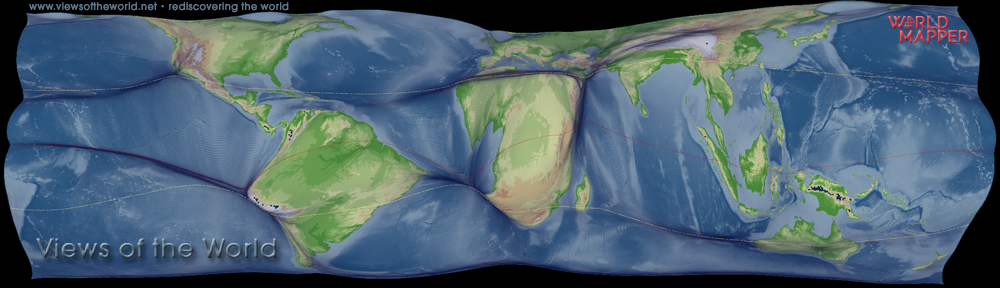
Unlike the post-apocalyptic scenario in infamous Waterworld, what would a world without oceans look like? An oceanless world, so to say, but not like one of the supercontinents that we already had. Instead, more like our today’s continents in the shape of the living space of humankind. In the digital era of cartography, this kind of map is just a few clicks (and much processing time) away, and results in this map curiosity: The image of the world as an oceanless population planet:

The map has been presented first at my talk for the DGfK‘s (German Cartographic Society) colloquium at the University of Applied Sciences in Karlsruhe (a German summary can be found here). In 2013 it has been published as a E&P A feature (see here).
As it was all about visualisation (and maps, of course), I used the Prezi presentation tool to visualise this talk. Here it is:
Ancient Worldmapper Map
Surprisingly this ancient map shows the world’s population of the year 2005:

The content on this page has been created by Benjamin Hennig. Please contact me for further details on the terms of use.