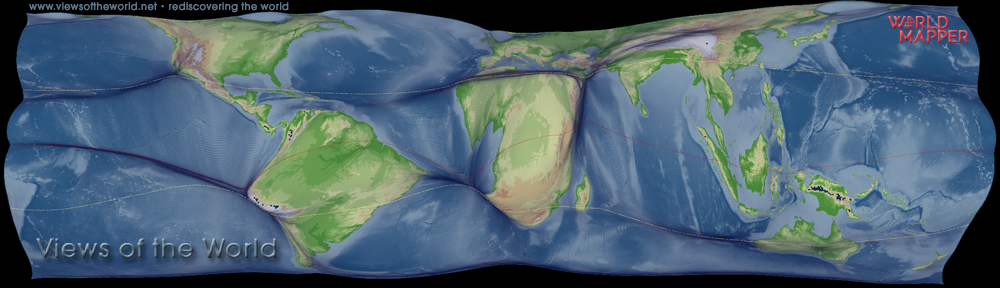

This map is created using the approach described in the book Rediscovering the World and which is also summarised in this ‘Lonely Planet’ blog post, showing the remotest places of the island as the largest areas. Continue reading
Category Archives: maps
Changing Views of the World
The mental map of the world though the eyes of Guardian Online readers in recent years may look a little bit like the following cartogram adding up the distribution of all online news items in the period of 2010 to 2012 (excluding the coverage of domestic British news):

The picture confirms very much the hotspots of political, economic and in smaller proportions also natural events at the start of the new decade that we are now well into. Following the map series of Guardian Online news coverage in recent years, the following maps demonstrate a different approach to how change can be mapped in cartogram form. Rather than using the absolute values for a topic, when having a time series one can also look at the change between individual moments in time. So when wanting to see how the global news coverage of the Guardian website has changed between 2011 and 2012 one gets two sets of data, one indicating the absolute increase and one indicating the absolute decline in news items in that time. This is what the following two maps show, demonstrating which regions suddenly appeared or became more important in the media, and where the relevance and public attention dropped (while a stagnating news coverage – regardless of it being very high or very low – is not reflected in this approach and better shown in the absolute mappings that were shown in the first part of this data analysis):
Increase in Guardian Online News Coverage between 2011 and 2012
(excluding the United Kingdom)

(click for larger version)
Decline in Guardian Online News Coverage between 2011 and 2012
(excluding the United Kingdom)

(click for larger version)
Not as patchy as it looks: Higher education institutions in the UK
Despite the apparently inequitable clustering of universities in certain hot spots across the UK, the correlation between where people study and the distribution of the general population is surprisingly strong. This analysis focussed on the mere geographic distribution and size of UK Universities rather than taking additional features such as quality of teaching or research into account, but already provides an interesting insight into how these institutions are spread in relation to the population:
(click for larger version) Continue reading
Everything’s Changing: A World of News
This is a map series visualising a comprehensive data set kindly provided to me on request by the editors of the Guardian Data Blog a couple of months ago (special thanks to Peter Martin and Grant Klopper for this!). The work on these maps started with the idea to make an update of the still quite frequently accessed maps of global news coverage of the Guardian.co.uk news website that I created for the years 2010 and 2011. As explained back then, while being the snapshot of one single newspaper this data also gives some indications of the way the countries of the world are represented in the print media in the United Kingdom, hence giving a picture of how the world looks through the eyes of the British people (it’ll vary slightly for other media outlets, though the overall picture will result in similar patterns).
I have now updated this map using the most recent data that the data store team sent to me (unfortunately it is not available in the data store this time). The data lists the total number of news items on the website of the British Newspaper The Guardian that are tagged with a specific country name. For the year 2012 the news coverage (leaving out the United Kingdom) on their website was distributed as shown in this cartogram:

With the United States being consistently the second largest country represented in the data (after the UK which is excluded in this map) it should be mentioned that this may not only be explained with a certainly quite prevalent US-biased media coverage in most of the British press, but could in the case of the Guardian also be explained with the additional fact that the Guardian is expanding its media activities more and more actively across the Atlantic (also launching a dedicated online US edition in 2011), and indeed worldwide, as the very recent move to the domain http://www.theguardian.com/ suggests.
With having a series of three years (ranging from 2010 to 2012) available, I was now able not only to look at an update to the previous maps, but could also start a little look into the changing patterns that emerge from the data. The following animation shows how the news coverage has shifted in this period:

World Lightning: Thunderstorms and human population
Time again to talk about the weather: Britain is suffering under heatwave conditions (also known as summer in other parts of the world), with the ongoing high temperatures and developing clouds going along with an increased humidity slowly increasing the risk for thunderstorms. Thunderstorms are not an uncommon phenomenon on the British Isles, but they are much less common and much less severe compared to other regions experiencing similar conditions much more frequently and more intensively. The Met Office explains that “Owing to the fact thunderstorms are created by intense heating of the earth’s surface, they are most common in areas of the globe where the weather is hot and humid. Land masses therefore experience more storms than the oceans and they are also more frequent in tropical areas than the higher latitudes. In the UK thunderstorms are most common over the East Midlands and the south-east.”
As it happens to be, the part most prone to thunderstorms in Britain is also the most densely populated region. Comparing this to other parts of the world, it can be seen that some of the most risky regions are also some of the very densely populated places. In Europe, which is overall densely populated in many parts, the most affected areas are the people living in the Mediterranean countries, although the European population in general is amongst the least affected by thunderstorms when comparing this to areas such as the southern edge of the Himalayas in India – densely populated and experiencing very intensive thunderstorms. These details only emerge when changing the projection of data collected on lightning flashes from a conventional land area map (where this part of India for instance remains comparably small) to a gridded population cartogram. The following map shows the intensity of lightning flashes displayed as the number of flashes per square kilometre per year in each of the grid cells, while the distortion of the grid cells reflects the global population distribution, so that the most and least exposed populations are highlighted in this visualisation:

European Agricultural Spending
The EU27 is history, with Croatia becoming the 28th member state of the European Union today. On last week’s European Council meeting, the ‘old’ members had other issues in mind, as the common agricultural policy (CAP) was one of the critical issues in negotiating a new seven year budget. The proposed changes in subsidies in this field of spending are quite important, as this part of the EU policies started a process of considerable changes in the agricultural landscapes in Europe over the years. The area of spending is not least relevant, as together with the rural development funding agriculture counts for almost 40% of the budget (see this map series about EU spending for more details).
The agreements that were reached are also significant, as the agricultural budget mainly serves the economically and politically strongest countries in the European Union. The following cartogram shows the redistribution of spending on the agricultural markets within the EU27 in 2011 (the most recent data available from the European Commission), which counts for €44,898 million of the overall €129,394 million budget:
