 In 2007 nature conservation organisation WWF initiated a campaign “encouraging households and businesses to turn off their non-essential lights for one hour to raise awareness about the need to take action on climate change” (Wikipedia). The campaign is called Earth Hour and always takes place at the end of March – this year on Saturday, the 23rd.
The Earth Hour campaign has motto of “uniting the world to protect the planet”, although certainly not everyone will join in switching off their lights at 8.30 pm to unite each time zone with a dark night sky (and there is criticism of campaigns like this). But the wealthier parts of the world will be the main focus, as large parts of the poor world live in relative darkness at night anyway. NASA’s composite satellite image of the world at night (as featured on this website before) that gives us an indication of where light pollution affects most of the night skies has just received an update recently. Earth at Night 2012 was published by the NASA Earth Observatory last December, promising nothing less that “It’s the end of the night as you know it; you’ll see fine.” The resolution and level of detail revealed in the data is stunning, so that I reworked my version of the Earth at Night in an equal population projection using a gridded cartogram transformation. The new gridded population cartogram of the Earth at Night gives an equally stunning insight into how human activity relates to the distribution of light at night, showing the already highlighted inequalities that became apparent in the old version of the map in even greater detail where large parts of the populations in Africa and also in some parts of Asia live in the shadows of the wasteful brightness of the wealthy world. The Earth at Night as seen by humanity – an image of an unequal world:
Category Archives: maps

A Military World
World military spending for 2011 is estimated to be over $1.7 trillion at current prices, and has come to a relative stagnation after it has been steadily rising in recent years. As summarised on the Global Issues website, “the 15 countries with the highest spending account for over 81% of the total; The USA is responsible for 41 per cent of the world total, distantly followed by the China (8.2% of world share), Russia (4.1%), UK and France (both 3.6%).” The data cited here comes from the SIPRI Military Expenditure Database compiled by the Stockholm International Peace Research Institute who use publicly available data sources for its reports. Military expenditure is defined as “all current and capital expenditure on: (a) the armed forces, including peacekeeping forces; (b) defence ministries and other government agencies engaged in defence projects; (c) paramilitary forces, when judged to be trained and equipped for military operations; and (d) military space activities. Such expenditures should include: (a) military and civil personnel, including retirement pensions of military personnel and social services for personnel; (b) operations and maintenance; (c) procurement; (d) military research and development; and (e) military aid (in the military expenditure of the donor country). Civil defence and current expenditures on previous military activities, such as veterans’ benefits, demobilization, conversion and weapon destruction are excluded.”
SIPRI’s long term observations show how the decrease in military spending following the end of the cold war in the 1990s slowed down at the turn of the century, and has significantly been rising again over the last 10 years – now exceeding the levels of the 1980. A major impact on these figures has the revival of military spending in North America, as the regional breakdown of the data shows. Compared to that, the rise of Asia appears much less significant than one would expect, although the region is clearly gaining importance (see an interactive graphic of the data on the Guardian datablog).
The following cartogram uses the latest available figures of military expenditure from the 2012 update of the database, completed by own estimates for the missing countries. It shows the estimate absolute expenditure in current (2011) US$ for the year 2011:

On the grid: Worldmapper and beyond
My research on gridded cartograms has its roots in the works of the Worldmapper project, which was originally released in 2006/07 and extended in the following years. While the first phase of the Worldmapper project has visually describes the world, mapping the national contours of hundreds of variables, it did so only in one way and a way easily open to criticism despite its novelty and wide scope. To tackle this, I conducted further research to help address these potential criticisms, to work on moving the resource beyond its simple descriptive form. This included a look at more theoretical issues of how world resources, flows and shares are understood, particularly visually understood – and how this can be improved.
The gridded cartograms are one of the key results of this second phase of the Worldmapper project to advance and improve the capabilities of the Worldmapper maps. So far we integrated gridded cartograms on the Worldmapper website only in form of the World Population Atlas that shows an extensive collection of gridded country cartograms. These are the first ever made compilation of maps showing population distributions in cartogram form at that level of detail for every country of the world, but there is more to the underlying technique than this.
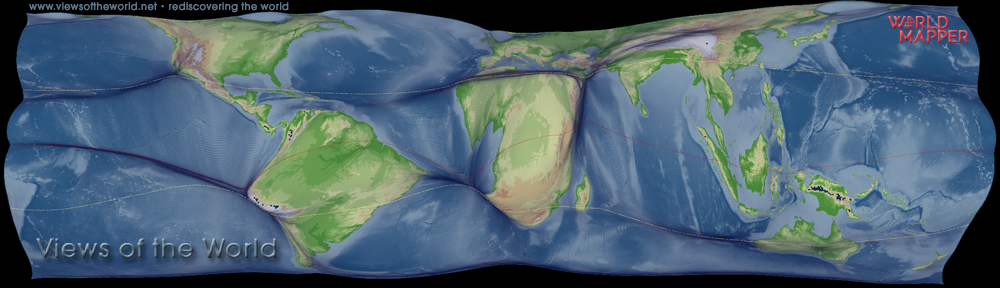
Following the release of these first maps using a gridded cartogram approach, I have made progress not only in enhancing the accuracy and quality of these country-level maps, but also in advancing the technique to a stage where gridded cartograms can be utilised as an alternative map projection (explained and discussed in full detail in my PhD thesis). Some examples are shown on this website: One example for the new capabilities at country level is the map of population changes in Germany. At global level the example of agricultural spaces presented at last year’s Annual Meeting of the Society of Cartographers demonstrates their applicability not only for population-related issues, but beyond that for other quantitative dimensions with a new level of detail, but also new capabilities of showing additional layers of information that the original Worldmapper approach was not capable of achieving.
There sometimes is a certain confusion about the differences between the maps drawn in the first stage of the Worldmapper project (and that we carry on producing as well), and the new gridded cartograms. The following map series shows the differences by using the Worldmapper colour scheme applied to the different map types (for full clarity, the map series starts off with a conventional map projection):

A New Image of the World

Cartograma cuadriculada de la población de Ecuador
The people of Ecuador are going to the polls today, voting at the first general election after the constitutional court resolved the Democracy Code in 2012. This comes at an interesting time from a British perspective, as WikiLeaks founder Julian Assange still calls London’s Ecuadorian embassy his home. Ecuadorians may care little about this international diplomacy row, and some may be more interested in issues regarding press freedom in their home country. But after many years of economic uncertainty and political instability following the collapse of the banking system in 1999, many other questions will rate far more important at these elections in a country that is extremely diverse for its size, not only in its nature, but also its population.
“Ecuador is a patchwork of indigenous communities, including people of colonial Spanish origins and the descendants of African slaves” (quoted from the BBC Country Profile Ecuador). For a country of only 283,561 sq km size (slightly smaller than Nevada, as the CIA World Factbook puts it), Ecuador has a remarkably diverse natural environment: The continental area stretches from the tropical rainforests in the east over the Andean highlands to the low lying coastal zone. And 1,000 km westwards off the coast the Galapagos Islands form the volcanic outpost of the country.
The population of over 15 million people is concentrated in two of these four major regions: ‘La Costa’ – the coastal region – is home to Ecuador’s largest city Guayaquil (2.3 million people), while the capital Quito (1.6 million people) is located in ‘La Sierra’ – the highlands at an elevation of over 2,800 m above sea level). Despite their high altitude, the Ecuadorian part of the Andes is home to a considerable population almost equal to the coastal areas. The less accessible rainforest region as well as the the Galapagos Islands in contrast are home to only small numbers of people.
The distribution of Ecuadors population is visualised in the following gridded population cartogram (a ‘cartograma cuadriculada de la población ‘ in Spanish), which is a much improved display compared to the original version of this map that I created in 2009 for the World Population Atlas. The improved resolution is made possible by using the LandScan population data which in this case provides a better estimate for the real distribution of people than the SEDAC GPWv3 data. The map shows an equal-sized grid over the land area of Ecuador resized according to the total number of people living in each of the grid cells, so that larger grid cells reflect higher numbers of people, while depopulated areas almost disappear from the map.
The green to brown colours in the map reflect the altitude of the areas, so that the coastal and mountainous regions are clearly distinguishable. The transitional zones of intermediate shadings (and elevations) almost disappear from this map, which shows the relatively small numbers of people living where relief gradients are steepest. The rainforest region (La Amazonía, or also El Oriente as it is situated in the east) which makes almost half of the land area, is equally underrepresented in this map, as it is home to less than 5% of the population. This is the human shape of Ecuador:

The Worldmapper Rainbow
A question often asked about Worldmapper is in regard to our choice of colours for the different regions and countries. On the website we briefly explain that the colours used on the maps group the territories into 12 geographical regions, and allow for an easier visual comparison between the maps than would otherwise be possible. The shading of each territory within a region is consistent throughout all of the maps.” But there is a little bit more to the colours which tell a story about the unequal fortunes of the world which follow a general pattern along the major regions.
The colours of the world’s regions are chosen very consciously, and have a deeper sense behind their distribution. We split the world into twelve contiguous geographical regions of population groups, with every region being roughly symmetrically balanced and having at least a population of one hundred million people. This is how the world’s population is distributed:
 Continue reading