 The Eurozone crisis has made monetary issues the focal point of political debate about the nature of the European Union, not just within members of the common currency but across the 27 states that constitute the EU. Discussions about emergency bailouts and transfers to support struggling economies have distorted the public perception of the costs and benefits of the Union.
The actual EU budget is based on a multiannual financial framework, negotiated among the individual members and agreed upon at the level of European institutions. The current financial framework covers the period 2007–2013. Negotiations for the framework from 2014 to 2020 are under way. These discussions are greatly influenced by the implications of the current crisis. In a feature for the “In Focus” section of Political Insight (September 2012, Volume 3, Issue 2) Danny Dorling and I looked at the current financial framework and how the money is redistributed across the member states.
 Continue reading
Category Archives: presentations
The Visualisation of Spatial Social Structure: Reflections on Critical Methods
‘(How) do we understand Capitalism? Reflections on critical methods’ was the title of a workshop on critical methods at the University of Manchester (September 13-14th). As the announcement of the workshop states, ‘there is no consensus on what critical social science is, exactly. Largely it is defined as not orthodox economics or positivist social science‘. Continue reading
From geovisualisation to neocartography: Maps in a digital world

Changing technologies have always had a considerable impact on cartography and continue to do so. Several technological revolutions marked important steps in the practice and process of creating maps. Mechanical, optical and photo-chemical technologies changed the way maps were produced. Then, the discovery of electronic capabilities made a new dimension in map production accessible: Not only most of the design techniques were transferred to digital platforms, used at some step in the production of almost all maps created today, but also the possibility to deal with huge amounts of data that can hardly be analysed by a single person enables cartographers to find ways to automate data processing for cartographic visualisation. This is where the term neocartography comes into play, which gives credit to the most recent trends in the field of map-making. Continue reading
A Tale of Two Cities: London’s Health Inequalities
“London is a special city, London is incredibly diverse and London has its own unique health problems. In 2012 the London Deanery, in partnership with the British Medical Association, is hosting a series of seminars that look to provide […] an opportunity to debate some of the key healthcare issues that face the capital in 2012.” This extract from the announcement of the Metropolitan Medicine 2012 seminar series highlights the need to take a closer look at London’s position within the United Kingdom, as the challenges that the city faces are probably not different, but certainly unique to the problems that currently exist in the health sector of the country.
A tale of two cities: London’s health inequalities was the title of my contribution to the seminar series. In my presentation I highlighted some of the problems that are part of that issue, explaining how social and health inequalities are inevitably intertwined. London is unique in the social landscape, but also part of the processes that shape the UK, which I demonstrated in a series of maps in my slides that accompanied my talk: Continue reading
Mapping the global village
Changing times was the title of a session at this year’s Annual Symposium of the British Cartographic Society (not to be confused with the Society of Cartographers which will have its annual conference in September).
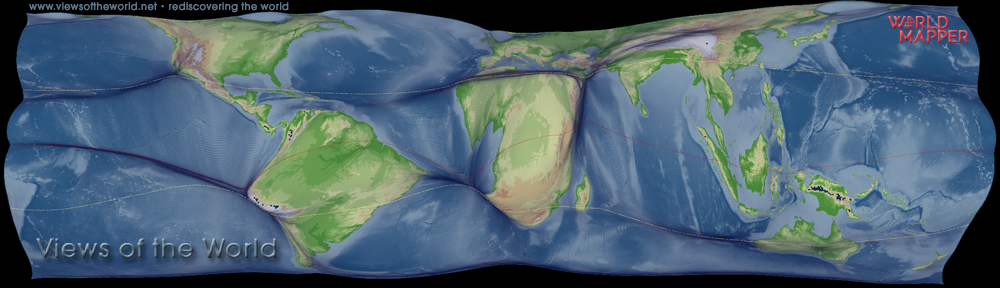
My contribution as a speaker in this session was titled Changing views of a changing planet. In the presentation I took a look at how changes in data and technology can provide alternative ways of mapping a globalised world, and mapping cities as the hotspots of globalisation. Continue reading
Where does it always rain on us?

Does it never rain in Southern California? And can we find the rain in Spain mainly in the plain? And what does that all mean for the people living in these places? Where does rain matter most for the population? In some places, it can be a much needed scarcity, elsewhere it appears in a much dreaded surplus. Wherever it is falling, rain matters a lot where people are. Partly, the global population distribution can be explained by climate patterns, with rain being a crucial factor for the agriculture in a region. In my presentation for the delegate’s session at this year’s 47th annual meeting of the British Society of Cartographers in Plymouth I took a closer look at the weather, or to be more precise, at climate patterns and their visualisation using gridded cartograms. Part of the presentation was an animation showing the global precipitation patterns projected on a gridded population cartogram. The following map shows the annual precipitation in relation to the global population distribution. The small map inset gives the conventional view of the same data, demonstrating how the perspective changes when seeing the same topic from two different views: Continue reading