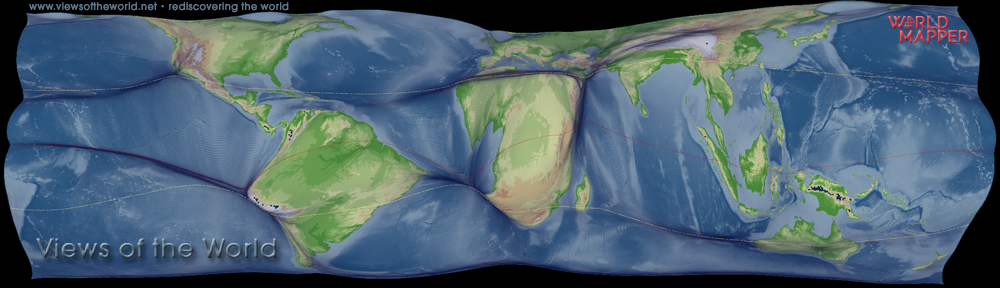
According to the British Guardian, 2011 was the year of the news overload, with many people perceiving the year’s news from around the world being extremely significant in manifold ways. “There is no news“, as reportedly broadcast by the BBC an a day in 1930, is an unlikely in our media age, but whether last year’s news were more significant than usual remains another question. It may just as well be a proof of an increasingly connected world where news become ever more instant and people demand new news virtually every second – the news overload of 2011 may therefore also be a result of the overload of news produced by the media (and demanded by the population). Continue reading
Tag Archives: worldmapper
Material flows: Global resource extraction
Climate change as discussed at the climate talks in Durban is just one of the complex impact that humans have on the natural environment. The history of humanity is closely linked to benefiting from (or exploiting) the natural environment in order to improve living conditions. “Stone, Iron, Bronze and Steel Ages – the names of these periods have been chosen according to the main materials in use” Continue reading
Carbon Emissions – an update
Starting today the world gathers in Durban for the COP17 climate change summit. In times where economic growth is more anticipated than a decline in carbon emissions, the prospects for a successful successor to the Kyoto protocol (coming to an end in 2012) is quite unlikely, and it will be interesting to see, what ‘success’ the delegates have to announce for saving the world from mad and often also tragic consequences of changing climate patterns. Continue reading
Landmines
In a report released by the Landmine Monitor it is stated that landmine use is ‘highest since 2004’ despite record clearances. While with Burma (Myanmar), Israel, Lybia and Syria, four of the 20% of countries who did not sign an international treaty to stop the use of land mines, continued to use new devices this year (and further armed groups in countries such as Afghanistan, Colombia and Pakistan also laid new mines, as reported by the BBC), the deadly impact of these weapons reaches further than those countries. Continue reading
57 million deaths
People are dying all the time. Wars are just one of the many causes of death, but certainly one of the more avoidable ones. WHO’s Global Burden of Disease (GBD) study is the key publication containing global health statistics which can help to understand the relevance of geography in relation to the mortality patterns and the prevalence of certain diseases. Continue reading
A Nuclear Planet
A report by the International Atomic Energy Agency (IAEA) is warning that “Iran appears to be on a structured path to building a nuclear weapon”. Are they…are they not? The possession of nuclear weapons is a well kept secret, also for those countries that are known to be part of the club of world nuclear forces. The Federation of American Scientists states that “the exact number of nuclear weapons in each country’s possession is a closely held national secret. Despite this limitation, however, publicly available information and occasional leaks make it possible to make best estimates about the size and composition of the national nuclear weapon stockpiles”. Using their data suggests, that there may be a total inventory of about 20,500 nuclear weapons that separates us from the vision of a nuclear-free world outlined by US President Obama in 2009 (meanwhile, priorities appear to have changed, with expert outlines for steps toward a nuclear-free world having been moved to an archive of the US foreign policy website). The reality looks very different, and Iran would only be one more member in a bipolar world that still very much reflects the nuclear arms race of the cold war. The following map is an update to the Worldmapper Nuclear Weapons cartogram using the 2011 estimates for the possession of nuclear weapons by the FAS:
