Starting today the world gathers in Durban for the COP17 climate change summit. In times where economic growth is more anticipated than a decline in carbon emissions, the prospects for a successful successor to the Kyoto protocol (coming to an end in 2012) is quite unlikely, and it will be interesting to see, what ‘success’ the delegates have to announce for saving the world from mad and often also tragic consequences of changing climate patterns. Continue reading
Tag Archives: cartography
Rediscovering the World
Featured

Visualisations of a World in Crisis

Cancun Climate Change Conference
Climate change has hardly been on the agenda of global politics recently. It was the global downturn which keeps country leaders busy, and so prospects for the current climate change talks in Cancun (Mexico) to find a successive agreement for the Kyoto protocol appear quite poor. While the Copenhagen summit in 2009 was accompanied by large hope (and failed miserably), there are much lower expectations this year, although still some hope for a significant outcome.
It is interesting to look at the number of delegates which a country is able to send to the talks, as this reveals a lot about the interests of the nations that will succeed in the negotiations. The voices which will be heard are probably the voices of those who send the most delegates, riding roughshod over those nations which have fewer representatives. But the number of delegates may also reflect the importance that climate change has on the political agenda of a country.
During the next days the summit goes into its critical phase, with (perhaps) some world leaders appearing on stage to strengthen their voice – but will those voices from the most vulnerable countries be heard? This is the map of the number of delegates in this year’s climate change talks (data obtained from the UNFCC, the map has been cated in collaboration with UNfair play):

And there is a lot to discuss in Cancun, not least because developments look bleak when looking at the latest figures on carbon emissions: A year ago on the occasion of the Copenhagen summit I published an updated map on the global carbon emissions. I also did a new map depiction modelling the carbon emissions onto a grid which gave a clearer picture of the geographical variation of these emissions. The figures back then were based on UN data for 2006, so that since than inevitably many inquiries came in asking for a more recent map.
Combining several data sources (mainly UNStats and IWR) and taking the just released Update on CO2 emissions (by Friedlingstein et al published in Nature Geoscience) we now updated our worldmapper base data to a consistent data set which allows us to draw a more recent picture of carbon emissions amid the economic recession. The map reflects the findings in the above mentioned paper: Despite the slowdown in global production, global emission rates continue to rise. The research also confirms a simultaneous development of carbon emissions and GDP, resulting in often only moderate reductions of emissions in most affluent countries and continued increases in many emerging economies. According to their estimates, 2010 may become the year with the highest anthropogenic carbon emissions in history – a new piece of history, just as the Kyoto Protocol. Did anyone say something about an economic crisis? What would the world look like without a crisis? Perhaps the next years will tell us…again. – Here is the updated map and below a short animation showing the slight changes from 2006-2009:
Carbon Emissions 2009:

(click for larger version)
Animation CO2-Emissions 2006-2009: Continue reading
Mapping a (un)happy humanity: a new perspective on our planet’s well-being
Happiness and well-being found their way back into public debate in the UK with Prime Minister David Cameron wanting well-being to become a measure to steer policy. Maybe he was inspired by his recent trip to the G20 meeting in Asia: On the Asian continent lies the first country to have introduced Gross National Happiness as a measure for the country’s development – rather than economic growth, like we keep on doing. Happiness as the new economics is an appealing thought, but it is hard to imagine any major economy looking at happiness instead of money any time soon. And if so, how would the world look like? Happiness is hard to measure, and hence data is hard to get. One way to look at the well-being around the world provides the Happy Planet Index by the nef (new economics foundation).
Last year Sheffield University’s CWiPP is holding an exhibition at the ICOSS to mark the re-launch of the centre. My poster showing a new map of the Happy Planet Index was part of the exhibition:
 Download poster as PDF

This map is also featured in the News section of the Happy Planet Index homepage.
Update March 2011: I have given a talk explaining the methodological background and the thematic relevance of the map at the IDEA CETL Seminar Series (University of Leeds). The slides of this talk are available here:
Mapping people, not sheep: Why our planet’s well-being can look so different
Update March 2011: I have given a talk explaining the methodological background and the thematic relevance of the map at the IDEA CETL Seminar Series (University of Leeds). The slides of this talk are available here:
Mapping people, not sheep: Why our planet’s well-being can look so different
The content on this page has been created by Benjamin Hennig. Please contact me for further details on the terms of use.
Serpentine Gallery Map Marathon
This map is part of this weekend’s Map Marathon at the Royal Geographical Society in London. It is an event of Serpentine Gallery and was conceived by curator Hans Ulrich Obrist (here an interview with him talking about the event) . This is a quote from the official announcement:
The Serpentine Gallery Map Marathon will bring together an unprecedented group from diverse fields to showcase possible maps for the coming decade. The Map Marathon will explore all forms of mapping, of data, space and time, multiple dimensions, language and the body. The event will uncover the influence and possibilities of mapping in our world today.
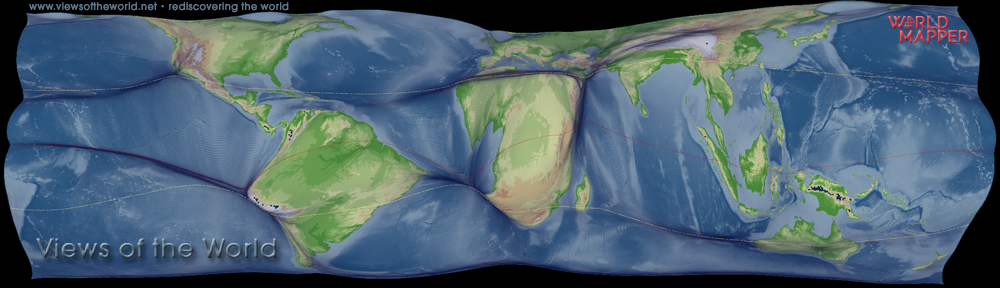
A similar version of this map has already been shown in some of my presentations (and those of the Sasi Research Group), and it is also a contribution for the forthcoming “Maps for the 21st Century” book to be published in 2011:

And this is part of the caption that goes along with the map: The new world map creates an unprecedented view on the world’s population which allows new perspectives for mapping the social dimension of our planet. The projection creates space in areas that matter most in a human world. Mapping the physical terrain onto this map reveals at which elevation most people live on earth. Most people living at high elevations live in East and South Africa, whereas in East Asia the densely populated coastal plains become apparent.
Continue reading