
In the year 2000 there were approximately 15 million square km of cropland and 28 million square km of pasture which are represented in the two main maps. These are equal to 12% respectively 22% of the ice-free land surface. This is according to estimates of a study on the geographic distribution of global agricultural lands by Ramankutty et al (published in Global Biogeochemical Cycles, 2008) who used a methodology of combining agricultural inventory data and satellite-derived land cover data to come to these figures (data can be accessed via Columbia University’s SEDAC). Continue reading
Tag Archives: environment
Biodiversity hotspots – a world at risk
 With Lonesome George an international icon for conservation has died (although there are still chances that his subspecies of the Pinta Island tortoise (Chelonoidis abingdoni) will continue to exist). The extinction rate of endangered species however remains high and some say may even be the Earth’s sixth mass extinction. Less controversially it can be stated that the current extinction rates are higher than one would expect without humankind’s influence, and that more action to preserve the environment is needed. Continue reading
Shared rain
This April has been the wettest April on record in the UK, while parts of the country are also in official drought – leading to headlines of the wettest drought on record.
The miserable weather was (is) a good opportunity to finally produce a high-resolution version of the map series that I created during my PhD research and which I presented at last year’s conference of the Society of Cartographers in Plymouth. Continue reading
Material flows: Global resource extraction
Climate change as discussed at the climate talks in Durban is just one of the complex impact that humans have on the natural environment. The history of humanity is closely linked to benefiting from (or exploiting) the natural environment in order to improve living conditions. “Stone, Iron, Bronze and Steel Ages – the names of these periods have been chosen according to the main materials in use” Continue reading
Carbon Emissions – an update
Starting today the world gathers in Durban for the COP17 climate change summit. In times where economic growth is more anticipated than a decline in carbon emissions, the prospects for a successful successor to the Kyoto protocol (coming to an end in 2012) is quite unlikely, and it will be interesting to see, what ‘success’ the delegates have to announce for saving the world from mad and often also tragic consequences of changing climate patterns. Continue reading
A Solar World
British people are said to have an obsession for the weather. Therefore it is not surprising that weather stories have a common place in the media. A recent article in the Guardian’s Weatherwatch series (read more in Weatherwatch: Forget the Balearics – come to Bognor) was searching for the sunniest place in Britain. People living across the Channel may be quite surprised to hear that the concept of sunshine is known (or at least, does exist) in Britain, but it does. British holidaymakers may have actually been much better off staying on the island, rather than heading towards the European continent, as it turned out to be a quite wet summer 2011 there (but the records claim that it wasn’t much better on the British Isles either…).
Globally seen, and with a slightly more scientific twist, there is of course quite a lot sunshine in the northern hemisphere during the (northern) summer months. NASA Earth Obersavations regularly releases data of the solar insolation (the intensity of the sunlight that reaches the earth surface) on a monthly basis (see here for the data source and further details). The original NASA image (included in the below map as an inset) shows “where and how much sunlight fell on Earth’s surface during the time period indicated. Scientists call this measure solar insolation. Knowing how much of the Sun’s energy reaches the surface helps scientists understand weather and climate patterns as well as patterns of plant growth around our world. Solar insolation maps are also useful to engineers who design solar panels and batteries designed to convert energy from the Sun into electricity to power appliances in our homes and work places. […] The colors in these maps show how much sunlight (in Watts per square meter) fell on the Earth’s surface during the given time period” (quoted from NEO).
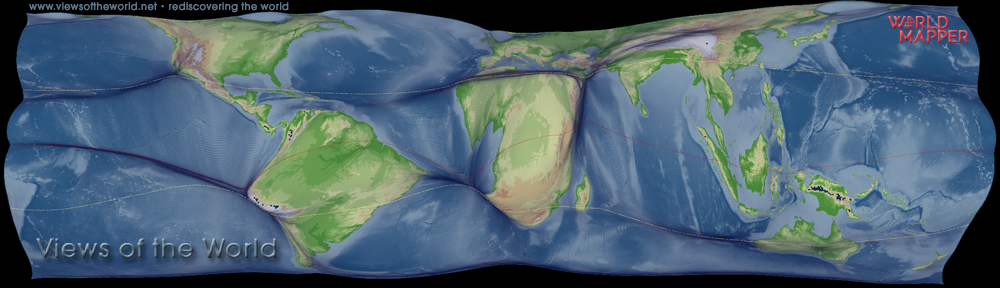
I used their data for a more experimental approach to visualise the most recent solar insolation (showing data for July 2011) using a gridded cartogram transformation. Instead of transforming people, the following cartogram resizes each grid cell according to the total energy of incoming sunlight reaching the land surface during the month July 2011. The cartogram shows the dominance of sunlight in the northern hemisphere during the northern summer season in the month just after the summer solstice. The seasonal variation of sunshine and the different distribution of sunlight between the northern and southern half of the planet become visible in their quantitative distribution. The northern landmasses are oddly bulging out of the map, while Antarctica disappears in the dark of the polar winter:
