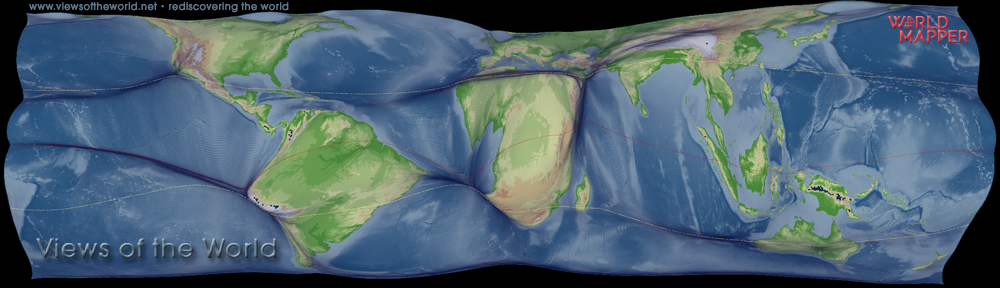
499 years after Mercator’s birth we may feel that the age of discovery is long gone. We seem to have explored almost every patch of our planet, considerably supported by Mercator’s famous world map that allowed sailors for the first time to reliably navigate across the world’s oceans. His innovation was a significant contribution to the early days of globalisation. Globalisation has turned our planet into a human planet, where people have become a substantial component of the processes that influence our livelihoods – some go as far as calling this a new geological era, the anthropocene. But while we have maps and images of every spot of the earth, we do not fully understand the human environments and interrelations to the natural environment. Normal maps show where sheep and other lovely creatures of nature live but hide much of the so important populous spaces of humanity.
The maps that I created as part of my PhD research are based on a novel cartogram mapping technique, deploying Gastner/Newman’s diffusion-based cartogram algorithm in a new way. The maps give every person living on this planet the same amount of space, while reducing the least populated places to a minimum. The map projection is calculated from an equally distributed population grid so that, unlike in other cartograms, the transformed grid cells preserve an accurate geographical reference. This allows us to map a diverse range of geographical layers on top of the population projection. The new maps show the social and physical environment in relation to population and provide a fresh perspective on the complex geography of the 21st century world. The following animation shows a series of maps that demonstrate the visual capabilities of the technique (the video can be switched to HD resolution by clicking the 360p note in the bottom panel):
Continue reading
Category Archives: presentations
Mapping people, not sheep: Why our planet’s well-being can look so different
Today I held a talk at the IDEA CETL Applied Ethics Research seminar at the University of Leeds. My talk was titled ‘Mapping people, not sheep: Why our planet’s well-being can look so different’ and focused on issues of mapping well-being in new ways. Continue reading
Demographic Change in the UK and the Environment
 The new 29th report by the Royal Commission on Environmental Pollution explores the environmental challenges faced by the UK as a result of demographic change. The cover of the report features my population cartogram of the United Kingdom surrounded by the commissions royal blue (see larger image of the cover map here). The report also happens to be the last work of this Royal Commission, which together with several other Defra bodies will be abolished later this year in its 31st year of existence.
Yesterday’s (16/02) official launch of this report in London was accompanied by a vigorous debate about the key findings, with much of the discussion being closely related to the demographic trends in the United Kingdom and which implications these have. Continue reading
Visualisations of a World in Crisis

A Picture of Open Access
The Open Access Week is promoting Open Access as a new norm in scholarship and research. It goes into its 5th year in 2011. The community claims that
Open Access (OA) has the potential to maximize research investments, increase the exposure and use of published research, facilitate the ability to conduct research across available literature, and enhance the overall advancement of scholarship. Research funding agencies, academic institutions, researchers and scientists, teachers, students, and members of the general public are supporting a move towards Open Access in increasing numbers every year. Open Access Week is a key opportunity for all members of the community to take action to keep this momentum moving forward.
Following up the Open Access Africa 2010 conference in Nairobi/Kenya Rania Baleela and Pablo de Castro Martín have created a presentation the global development of Open Access (and draw a special focus on the situation in African countries). They used a number of worldmapper maps to make their case. In addition I created a new map for them that shows the number of activities by country along the SPARC-organised 4th edition of the Open Access Week (Oct 18-24th, 2010). This is the newly created map on the OA 2010 activities (the full presentation can be accessed online in the e-archive of the University of Madrid, Pablo has also written a brief report about OA Africa at the BioMed Central Blog):

Mapping a (un)happy humanity: a new perspective on our planet’s well-being
Happiness and well-being found their way back into public debate in the UK with Prime Minister David Cameron wanting well-being to become a measure to steer policy. Maybe he was inspired by his recent trip to the G20 meeting in Asia: On the Asian continent lies the first country to have introduced Gross National Happiness as a measure for the country’s development – rather than economic growth, like we keep on doing. Happiness as the new economics is an appealing thought, but it is hard to imagine any major economy looking at happiness instead of money any time soon. And if so, how would the world look like? Happiness is hard to measure, and hence data is hard to get. One way to look at the well-being around the world provides the Happy Planet Index by the nef (new economics foundation).
Last year Sheffield University’s CWiPP is holding an exhibition at the ICOSS to mark the re-launch of the centre. My poster showing a new map of the Happy Planet Index was part of the exhibition:
 Download poster as PDF

This map is also featured in the News section of the Happy Planet Index homepage.
Update March 2011: I have given a talk explaining the methodological background and the thematic relevance of the map at the IDEA CETL Seminar Series (University of Leeds). The slides of this talk are available here:
Mapping people, not sheep: Why our planet’s well-being can look so different
Update March 2011: I have given a talk explaining the methodological background and the thematic relevance of the map at the IDEA CETL Seminar Series (University of Leeds). The slides of this talk are available here:
Mapping people, not sheep: Why our planet’s well-being can look so different
The content on this page has been created by Benjamin Hennig. Please contact me for further details on the terms of use.