 Public spending cuts have been an important part of the political debate in Britain in recent years. In an article for the “In Focus” section of Political Insight (April 2016, Volume 7, Issue 1) Danny Dorling and I plotted the distribution of funding for the arts and universities in England.
The United Kingdom, and especially England, has become geographically extremely unequal. This inequality is not only seen in growing economic disparities within the population, but also becomes increasing visible across all parts of public life, such as science and education, as well as the arts. A report on arts funding in 2013, highlighted just how concentrated such funding was within London compared to the rest of the country. This represents the continuation of a now long-established trend.
Category Archives: publications

Multiple Dimensions of Poverty
Poverty and global development are not only on the agenda at the World Economic Forum in Davos. But despite positive trends being observed in the aftermath of the Millennium Development Goals poverty still persists.
As a successor to the Millennium Development Goals (MDG), the United Nations announced a set of 17 new Sustainable Development Goals (SDG) relating to international development. Still on top of the agenda remains the issue of poverty. Here the new goal is to ‘end poverty in all its forms everywhere’ by 2030, meaning to ‘eradicate extreme poverty for all people everywhere, currently measured as people living on less than $1.90 a day’ and to ‘reduce at least by half the proportion of men, women and children of all ages living in poverty in all its dimensions according to national definitions’.
There are trends in past decades that indicate major improvements in tackling the problem of global poverty. In relative terms, the original MDG goal of halving extreme poverty between 1990 and 2015 has been met. In developing regions, people in extreme poverty now make up 14 per cent of the population there, while most recent figures and estimates suggest that still over two billion people globally live on less than $2 a day, a measure used to measure ‘moderate’ poverty. This figure is also used as a base for the main cartogram below. The map modifies the size of each country according to the total number of people there who live on up to $2 a day according to the most recent available estimates. In addition, the colour shading uses information from the 2015 Multidimensional Poverty Index (MPI) to highlight the percentage of the population that is multi-dimensionally poor.

Mapping the Anthropocene
Featured
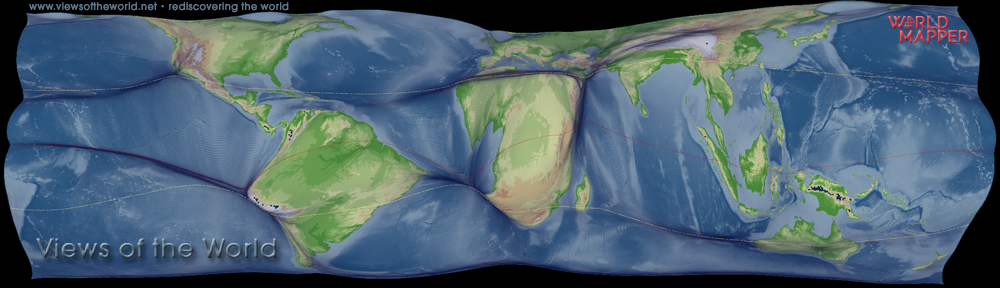
The effects of humans on the global environment are perceived to be so significant by some scientists that they argue the onset of industrialisation (in the eighteenth century) has been a major driving force in environmental change on a par with the forces of nature. It is this rapid impact that has led some geologists to unofficially name (but not, as yet, officially recognise) this recent period of the earth’s history (from around 1760-onwards) as the Anthropocene (roughly translating as the era – or epoch – shaped considerably through the actions of humanity).

Gridded population cartogram displaying the topography of the world in relation to the population distribution (click here for larger version)
World Religions
Religion as something “eminently social” as described by Durkheim finds its expression in the distribution of the major religious groups in the world. These have distinct geographical patterns to them, showing the regional influences that each of the groups define, as well as the spread of these influences in the course of history which have significantly changed over the past centuries.
Today, the three largest religions as well as the group of the non-religious put together make up 5.8 billion people, accounting for almost 80% of the world’s population. This highlights their importance in understanding some of the world’s social, cultural as well as political realities that define how people live together within countries but also between borders. As much as religion can unite and reconcile, it can equally be the cause of conflict and violence.
Conflict and peace are both elements that are replicated in the diverse religious shapes that emerge in the cartogram series of these four largest religious groups as assembled in the World Religion Database (adjusted to today’s populations).

In Focus: Europe’s uneven development
 The British debate about the United Kingdom’s membership in the European Union comes at a time in which the economic woes of the continent have not fully overcome yet. In an article for the “In Focus” section of Political Insight (December 2015, Volume 6, Issue 3) Dimitris Ballas, Danny Dorling and I looked at the changing regional economic geography of Europe.
Europe is in an economic crisis – but the crisis is felt in very different ways in different places. Official unemployment rates are high, especially in the south of Europe, but joblessness is very low in places, such as Germany

Ecological Footprints
 “There is no planet B”. This slogan has become widely mentioned recently in relation to COP21, the United Nations conference on climate change in Paris. The slogan highlights that the debate about climate change relates to much more than simply a changing climate. The underlying processes have a lot to do with our lifestyles and the related patterns of consumption and waste which cause severe damages to the environment (including the global climate). Carbon emissions are therefore one major trigger of climate change, but are also an effect of our unsustainable ways of life. The ecological footprint shown in the following map is a measure that looks at the impact that humanity has on our planet:
