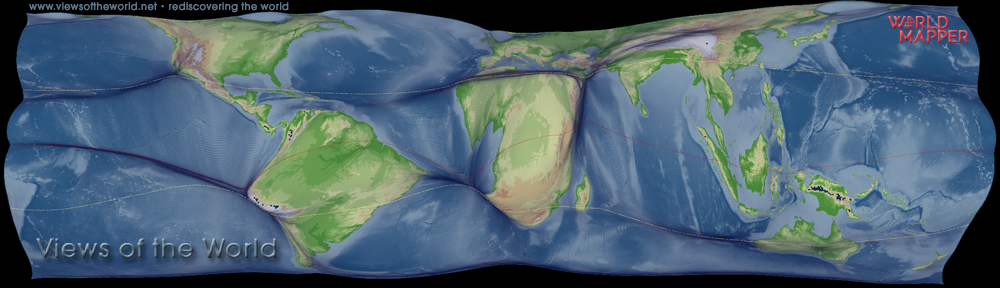
499 years after Mercator’s birth we may feel that the age of discovery is long gone. We seem to have explored almost every patch of our planet, considerably supported by Mercator’s famous world map that allowed sailors for the first time to reliably navigate across the world’s oceans. His innovation was a significant contribution to the early days of globalisation. Globalisation has turned our planet into a human planet, where people have become a substantial component of the processes that influence our livelihoods – some go as far as calling this a new geological era, the anthropocene. But while we have maps and images of every spot of the earth, we do not fully understand the human environments and interrelations to the natural environment. Normal maps show where sheep and other lovely creatures of nature live but hide much of the so important populous spaces of humanity.
The maps that I created as part of my PhD research are based on a novel cartogram mapping technique, deploying Gastner/Newman’s diffusion-based cartogram algorithm in a new way. The maps give every person living on this planet the same amount of space, while reducing the least populated places to a minimum. The map projection is calculated from an equally distributed population grid so that, unlike in other cartograms, the transformed grid cells preserve an accurate geographical reference. This allows us to map a diverse range of geographical layers on top of the population projection. The new maps show the social and physical environment in relation to population and provide a fresh perspective on the complex geography of the 21st century world. The following animation shows a series of maps that demonstrate the visual capabilities of the technique (the video can be switched to HD resolution by clicking the 360p note in the bottom panel):
Continue reading
Yearly Archives: 2011
The Disappearance of Childhood
Children are the living messages we send to a time we will not see.
(The Disappearance of Childhood, Neil Postman)
In the previous post I showed a map of the global distribution of malnutrition among the youngest children. To complete this picture, I used the same subnational Global Poverty Data from SEDAC and combined the data about the proportion of children with the total population (derived from the GPW database). Where information was missing, I used information from the national-level UN World Population Prospects to complete the data and generated a grid of the global distribution of children on a subnational level. The result of this is a new gridded cartogram display of the world’s children (aged under 5) which shows each grid cell resized according to the total number of children living there (as in many world maps on this website, I use the worldmapper colour scheme for the countries which makes the map easier to read). The following map therefore gives every child under the age of five the same amount of space, with additional information about the variation beyond the country borders. This is today’s world of children:

Hungry Children
After several of weeks in the headlines, the United Nations has eventually declared a famine in parts of the Horn of Africa today after large parts of the people there suffer from the worst drought in decades. Malnutrition is a much wider ranging problems in the poorer parts of the world, although it only comes to our mind when we see headlines as we do today. There are startling facts about malnutrition that are very contradictory to the wasteful lifestyles in the wealthy parts of the planet (a recent FAO study suggests that one third of the world’s food goes to waste): Continue reading
7 Billion
On July 11, 1987 the world population reached an unprecedented 5 billion, which was acknowledged with the establishment of World Population Day on that day ever since then. With the world’s population believed to reach 7 billion some time this year, this will obviously be a symbolic day (like it was back in 1987). But nobody knows how many of us are there exactly on this planet, and the number is constantly changing anyway. A nice animation of global statistics is shown in Worldometers, a website which turns all kinds of global statistics into live counts based on the estimated changes; at the time of writing this, the world population according to that website was at exactly 6,976,723,755…785…843…and counting; we also welcomed more than 208,000 new citizen to this planet while we also had to say goodbye to more than 95,700. Well, this is what World Population Day apparently is about: Making us think about the significance of population trends and related issues.
The worldmapper contribution to this year’s world population day is an updated version of the world population cartogram. The new map shows the countries of the world resized according to the total number of people living in each country in 2011 (using UNPD estimates). In a quick update, the world’s newest country South Sudan is also integrated in this map, so that this is the most recent population view that one can get of today’s countries:

Two Sudans
The human shape of the planet is constantly changing, so that the map of the world needs to be drawn every once in a while. On this 9th of July we are witnessing the birth of a new nation, with the south of Sudan officially becoming independent from its northern (now) neighbour. The following gridded population cartogram shows the population distribution within and between these two nations, giving every person living in the region the same amount of space. For the much smaller population in the south it will be hard work ahead in building a new nation, and for statisticians it will be similar hard work to improve on the population data that went into the creation of this map, as the pattern shows how crude the information about the population distribution in some parts of the two countries is – however, it still gives a good indication of where people living in the two new Sudans that are now on the world map:

A Blue Planet
Maney, the publishers of the Cartographic Journal have today released their Maney Feature of the Month ‘Cartography & Surveying’ about cartography and surveying. Part of that feature is my contribution about some of the mapping results of my PhD research. It focuses on a series of maps that show the gridded cartogram technique applied to various themes from the human and physical environment, and briefly explains the underlying method.
As this blog entry also happens to be the 100th post on the Views of the World website, I have created a new version of the gridded world population cartogram. The map shows our blue planet a little brighter than the version that I created for the Maney feature (which puts the main focus on the topographic display), and also displays the major rivers traversing the spaces of humanity as pulsing arteries of an essential element. This is the ‘Blue Human Planet’:
