What I heard about the world

The Earth at Night as seen by NASAThis iconic composite image of the earth at night of NASA’s Defense Meteorological Satellites Program is the world as we imagine it when the earth is not facing the sun. But this image does not tell the full story of the night’s world, as it suggests that it shows where people are (because there is light). There are actually many people living with little light at night (and perhaps many others wish for some less light, but live in one of the bright spots of this image). Therefore, this image is some kind of fake thing when it comes to the real world at night. The real world at night for the world’s population looks more like the following map, which has been shown on this website before (see here). The reason for showing it again is not only that it has become the header-image of this website, but because the theatre performance What I heard about the World recently incorporated this map in the show’s announcements:

The Earth at Night shown on a World Population Cartogram(click for large image)
See here for an updated and more detailed version of this map

Continue reading

Serpentine Gallery Map Marathon

This map is part of this weekend’s Map Marathon at the Royal Geographical Society in London. It is an event of Serpentine Gallery and was conceived by curator Hans Ulrich Obrist (here an interview with him talking about the event) . This is a quote from the official announcement:

The Serpentine Gallery Map Marathon will bring together an unprecedented group from diverse fields to showcase possible maps for the coming decade. The Map Marathon will explore all forms of mapping, of data, space and time, multiple dimensions, language and the body. The event will uncover the influence and possibilities of mapping in our world today.

A similar version of this map has already been shown in some of my presentations (and those of the Sasi Research Group), and it is also a contribution for the forthcoming “Maps for the 21st Century” book to be published in 2011:

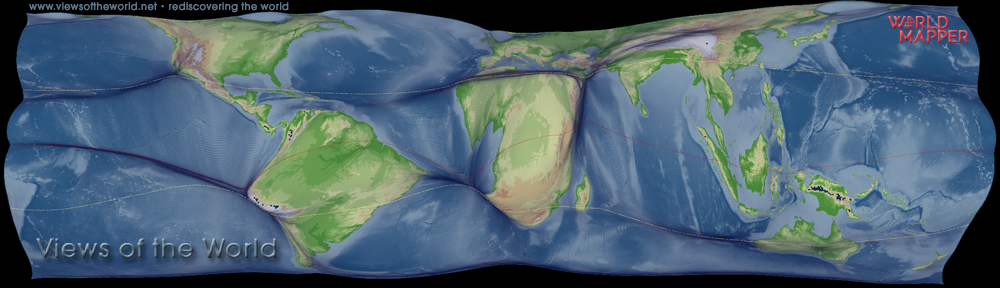
World Population Cartogram with a topographic map view
(click for larger view)

And this is part of the caption that goes along with the map: The new world map creates an unprecedented view on the world’s population which allows new perspectives for mapping the social dimension of our planet. The projection creates space in areas that matter most in a human world. Mapping the physical terrain onto this map reveals at which elevation most people live on earth. Most people living at high elevations live in East and South Africa, whereas in East Asia the densely populated coastal plains become apparent.
Continue reading

The Population of Germany

Today Germany is celebrating the 20th anniversary of unification of the until 1990 split East (German Democratic Republic) and West (Federal Republic of Germany). But while the areas have merged, in many people’s minds the division remains – recently prominently demonstrated in an interview by German chancellor Angela Merkel.
The dominance of the West is not least reflected by the population distribution between the two countries, with only Berlin being the most significantly populated area of the generally quite sparsely populated East of the country. Few other urban areas strike out when looking at the population distribution, which is displayed on the following gridded population cartogram. As the map in an equal-population depiction, each area of the map corresponds to the same number of people, so that the underlying geographical grid is distorted accordingly (reducing the size of less populated areas while increasing the size of the most populated areas). The colour code shows the population density in each of the grid cells (click the map to see further details in higher resolution):

German Population Density Mapped onto a Population Cartogram / Bevölkerungsdichte in Deutschland
(click for larger version)

Continue reading

Europe in debt

People across the worst hit countries by the proposed austerity measures to reduce national debt levels gathered on the streets of many European cities to protest against public spending cuts. The financial crash hugely affected many government across the EU with little signs of a quick recovery of the public debt levels.
The following map shows how Europe is left in deficit two years after Lehman (and that in fact the EURO zone isn’t worse off than EU members without the common currency). There may be signs of recovery, but this picture will certainly stay with us for a while:

Europe in debt: map of government deficit
(click for larger version)

Continue reading

Gridded Cartograms and the World Population Atlas

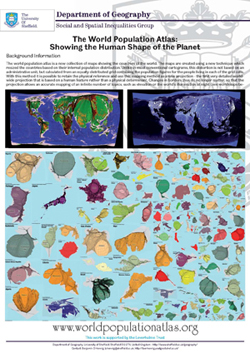
For this year’s 46th Annual Summer School of the Society of Cartographers I recalled the making of the World Population Atlas and wrapped all material up for some contributions for the meeting. The outcome are two new posters and a presentation for the delegate’s session:

The World Population Atlas: Showing the Human Shape of the Planet
Poster: The World Population Atlas
Poster: Gridded Population Cartograms: Drawing the Human Shape of the Planet
Poster: Creating Gridded Cartograms

The content on this page has been created by Benjamin Hennig. Please contact me for further details on the terms of use.

Magnificent Maps: Changing Perspectives

Magnificent Maps: Power, Propaganda and Art is an exhibition showing “80 of the largest, most impressive and beautiful maps ever made, from 200 AD to the present day”. The free exhibition still goes until 19 September 2010 at the The British Library in London.

The following map has been shown by Danny Dorling in one of the accompanying events. The lecture Changing perspectives: mapping global injustice by changing the view? introduced a series of maps using the gridded cartogram technique, some of which were shown to a wider audience for the first time. This map is a reprojection of the world according to the population distribution based on an equally distributed grid. The grid size in this map equals a 0.25° raster on a conventional map and a composite satellite raster image of the world has been transformed accordingly, so that the map reflects the population distribution in relation to the landscapes on which people are living:

Composite satellite image projected on a gridded world population cartogram
(click for larger view)

Continue reading