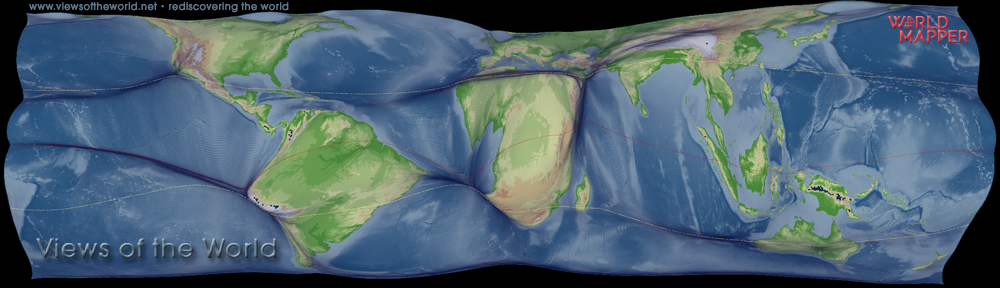
Building upon a previous publication investigating organic agriculture based on the reported hectares of certified organically managed agriculture land I have continued this little project in collaboration with John Paull to extend our attempt to quantify and map the world of organic agriculture, which led to the creation of a new atlas of organic agriculture. Here we compiled the following global organics data: (1) certified organic agriculture hectares; (2) certified organic producers; (3) total certified organic production hectares (organic agriculture plus wildculture plus forestry plus aquaculture); (4) certified organic wildculture hectares and mapped these using Worldmapper-style density-equalising cartograms. The maps illustrate the broad global diffusion of the organics meme, visually highlight leaders and laggers, and indicate opportunities for growth and better reportage.
In the world map of the organic agriculture hectares Australia dominates the picture, while Europe is strongly represented, and Africa is weakly represented:
Category Archives: publications

(Un)Happy Nations
Featured
March, 20th is the United Nations’ International Day of Happiness, recognising ‘the importance of happiness in the lives of people around the world’. Bhutan is credited as the first country to have implemented the concept of ‘Gross National Happiness’ as an official measure for the state of a nation, introduced in 1972. After the global financial crash in 2008, ideas about giving the ‘spiritual, physical, social and environmental health of [people] and natural environment’ more prominence over mere economic development are reflected more and more in international efforts towards a sustainable future.
The Happy Planet Index (HPI), developed by the New Economics Foundation, takes a rather radical approach on this issue. It aims to measure well-being and happiness by taking a universal and long-term approach to understanding, how efficiently people in a country are using their environmental resources to live long and happy lives.
This cartogram maps the results of the 2016 Happy Planet Index from the perspective of people. The gridded population cartogram shows the world resized according to the number of people living in each area, combined with the national HPI score:

Coast Lines

The question about the length of the world’s coastlines is not as easy to answer as it would initially seem. Continue reading
The Great Thaw: Mapping Arctic Sea Ice Thickness
Sea ice can be described as frozen seawater floating on the surface of the polar oceans. It does not include icebergs or ice shelves, as these are originating from glaciers, rather than sea water. Sea ice becomes thickest and most widespread over the respective winter months in each hemisphere, covering the oceans around the Arctic and Antarctic with millions of square kilometres of ice. It melts when the seasons change, but in the Arctic large areas remain covered all year around, while Antarctic sea ice melts away over the summer in the southern hemisphere.

Home Ownership in Britain
Housing has always been a decisive and sometimes divisive political issue. Home ownership has of course long been an aspiration for many people, and in the post-war period between 1953 and 1971 the number of households renting and owning reached an equal level, as documented in official census statistics for England and Wales. Ownership then surpassed renting, reaching its peak in 2001 at 69%. In the decade that followed, this number went down to 64%. The following two maps show the ownership rate in the UK in a conventional and an equal population projection:

In Focus: Trade Inside the European Union
 The outcome of the referendum over the United Kingdom’s membership of the European Union raises some crucial questions over the country’s economic relationship with the remaining 27 member states. Economic issues over trade were among the most heavily debated issues throughout the campaign. Now that the decision has been made, existing ties with the EU need to be carefully considered in any future trade relationship with the European Union. In a contribution for the “In Focus” section of Political Insight (December 2016, Volume 7, Issue 3) I mapped out Britain’s complex trading relations with the rest of the European Union and created a series of cartograms from the underlying statistics:
