
Geographic visualization in social sciences – or draw more maps! Continue reading
Tag Archives: maps
Where the Wild Spaces Are: Un planeta salvaje
Make the world a wilder place | Por un planeta más salvaje

Wilderness and remote areas are a diverse element in the patchwork of spaces that form the land surface of our planet. Only very small amounts of people are living in sparsely populated areas, which is an expression of the strong organisation of human societies to maximise those living in close relative proximity. More than half of the world’s population now lives in areas categorised as cities, and although more than 95% of the world’s population live in approximately only 10% of the land area, the remaining 90% of space on land are far from being uniform remote or even wild areas.
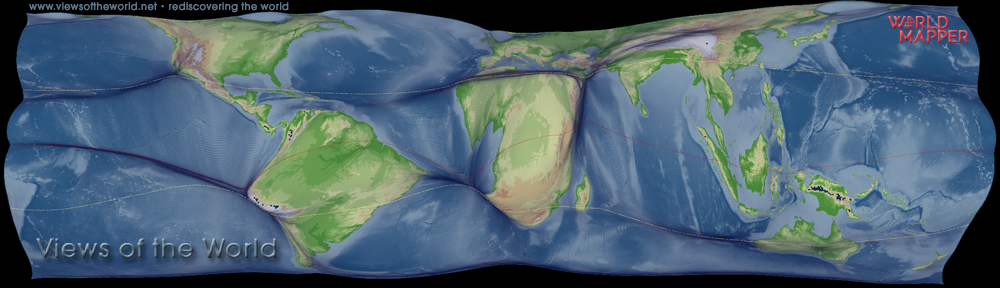
There are very different ways of how the un-built area that still makes the largest share of land can be understood in terms of being under influence and in reach of human civilization. Only 15% of people in rich countries live more than an hour of travel time from a city (of at least 50,000 people), while the same applies to 65% of people living in the poor countries of the world. This paper demonstrates a different approach to visualising and understanding these loneliest places on the planet by using a technique called a gridded cartogram transformation. The following map shows a gridded cartogram visualising the relative distance of areas to the majority of people. The maps derived from the distorted grid show the physical space transformed according to the absolute travel time that is needed to reach the nearest major city by land transport averaged over the area of a grid cell, resulting in a map that gives the remotest places most space and provides a unique new perspective on the spatial dimension of remoteness:

A New Image of the World

The Visualisation of Spatial Social Structure: Reflections on Critical Methods
‘(How) do we understand Capitalism? Reflections on critical methods’ was the title of a workshop on critical methods at the University of Manchester (September 13-14th). As the announcement of the workshop states, ‘there is no consensus on what critical social science is, exactly. Largely it is defined as not orthodox economics or positivist social science‘. Continue reading
Shared rain
This April has been the wettest April on record in the UK, while parts of the country are also in official drought – leading to headlines of the wettest drought on record.
The miserable weather was (is) a good opportunity to finally produce a high-resolution version of the map series that I created during my PhD research and which I presented at last year’s conference of the Society of Cartographers in Plymouth. Continue reading