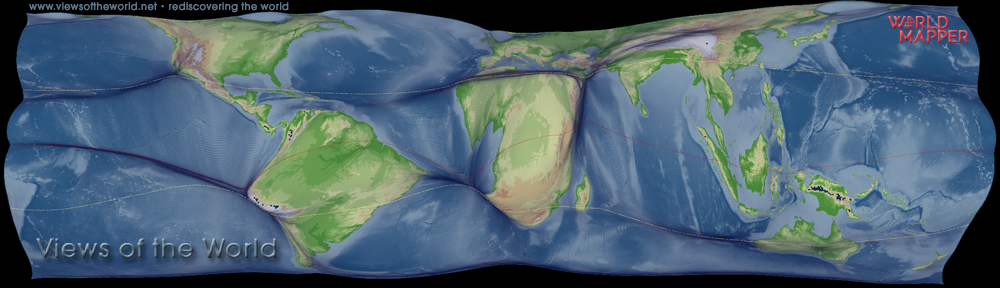
There is a new map in town! Earlier this month during the 125th Anniversary Conference of the Geographical Association in Sheffield (UK) we relaunched the new Worldmapper.org online platform which has been several years in the making. It is not only a fully redesigned website, but also redefines what we want Worldmapper to become over a decade after it has first been released: An atlas for the 21st century that is mapping our place in the world using cartograms.
At the very heart of it Worldmapper is still a collection of world maps where countries are resized according to a broad range of global issues. But with the new website we will increasingly use more diverse cartogram techniques, such as gridded cartograms, as well as start including maps at different scales such as country-level mappings seen on this blog in many ways. Worldmapper will therefore be the most comprehensive repository for cartogram-style mappings that are unique visualisations showing the world as you’ve never seen it before. Check it out at: Worldmapper.org Continue reading
Tag Archives: cartograms
Higher Education Students and Graduates in Europe
Featured
Promoting equity in education and training is consistent with the European welfare state model, with part of the Europe 2020 Strategy aiming to significantly reduce numbers of early leavers from education and increase numbers of graduates with a university degree. The following maps give an insight into the social and spatial disparities in higher education across Europe’s countries and regions. They are all gridded population cartograms where each area is proportional to the number of people living there.
This is a map of students as a percentage of the total population aged 20–24. The reported share can often be higher than 100%, where there are more students who study and live in a city in term time than the numbers of 20- to 24-year-olds that the city officially houses. Also many students are counted who are aged 18, 19 or over 24:

Political Landscapes of the United Kingdom in 2017
How much has the United Kingdom changed following the second general election within two years, and following the referendums on independence in Scotland in 2014 and the membership of the European Union in 2016? Each poll appeared to have had a significant impact on the political debate and the next vote which never seemed far away. As such, the 2017 general election looks like the culmination of the preceding ballots where all of the previous debates got a more or less prominent mention during the electoral campaign. Ultimately this led to some significant changes in the political landscapes of the country with each corner of the United Kingdom being affected by these dynamics.
Politicians, spin doctors and commentators quickly aim to interpret the outcome according to their views. In contrast, the following series of maps showing some key statistics and data from the election results aims to provide a more neutral as well as more comprehensive look at the underlying geographies. It shows different angles on key characteristics such as winners and runners-up in each constituency, changes in votes, vote shares of the two largest parties, turnout and changes in turnout between the last two general elections.
In this feature, different cartographic techniques are used to show how the electoral landscape in the UK is shaped not only by physical space, but also by political dimensions as well as from the perspective of people. The conventional (land area) map is therefore complemented by a hexagon cartogram where each parliamentary constituency is represented by a hexagon (some changes in constituencies over the past decades are reflected in split and merged hexagons), and by a gridded population cartogram where each area is resized according to the number of people living in that area.
Each of the three maps therefore provides a unique insight into the diverse spatial patterns of politics that emerged from the 2017 general election. To fully understand the new political landscapes of the United Kingdom, only a combination of different perspectives as shown here can help to gain a more complete picture. Geography matters not only in its physical dimension, but just as much in its social and political spaces that are depicted in these maps.
Here is the ultimate cartographic wrap-up of the 2017 general election in 21 maps:
Conservative vote share

(click for larger and labelled version)
Labour vote share

(click for larger and labelled version)
The regional geography of poverty, austerity and inequality in Europe
Featured
Europe is currently suffering a deep political and economic crisis following years of turmoil and austerity measures that have disproportionately and brutally hit the most disadvantaged regions and citizens across most of the continent. At the same time, there has been a revival of nationalisms and divisions in this part of the world that, a decade ago, seemed to be united in diversity and moving towards ever-closer union. Concentrated poverty near to riches and profound spatial inequality have long been persistent features of all European countries, with disparities often being most stark within the most affluent cities and regions, such as London. In other parts of Europe levels of inequality and poverty have been reducing and are often much lower. However, the severe economic crisis and austerity measures have led, in many cases, to an enhancement of existing disparities. The following eight maps show how the regional geography has changed in the light of these developments:

Destination: Iceland
1,767,726 people have visited Iceland through Keflavik Airport in 2016. These statistics from the Icelandic Tourism Board (Ferðamálastofa) confirm that there has been an exponential growth in tourism to the country. Six years ago, when this latest growth really started after the infamous Eyjafjallajökull eruption. It looks as if this incident triggered a new wave of tourism, Inspired by Eruptions?, further fueled by new flights not only from established European mostly low cost carriers but also from the new Icelandic carrier Wow air founded in 2011. Globally successful movies and TV series further helped putting Iceland on the map of the global tourism industry.

Warped worlds
 In 2013 German public broadcaster ARD made a documentary film about my work for their science programme W wie Wissen. This also features a range of cartogram visualisations that I produced for them. The following clip shows a compilation of the map animations that were shown in the feature, giving an impression of some of the cartographic works and visualisations that I have been working on over the past couple of years: Continue reading